CONNECTING (or the Gospels of Monk and Beefheart)
All things being equal, I’d rather be known as a good musician than as a good guitarist.
I’m not saying I’m either of those things, mind you. I’m speaking in strictly aspirational terms. The journey’s never over, and I’m light years away from where I want to be in both realms, but still…I’d rather be known as a good musician than as a good guitarist.
There’s a subtle distinction between those two things- one that laypersons (by which I mean those without the affliction of being compelled to create music) may not be aware of on the surface, but the distinction is there, and it’s an important one. That difference is what makes some music audio wallpaper and other music a miraculous, life-enriching experience.
I’d rather be known as a good musician than as a good guitarist.
For my purposes I’m using the term “guitarist”, because guitar’s my chosen instrument, the one that sank its teeth into me 40 years, three months and (*checks date*) six days ago, and never let go. But you can plug any other instrument into that sentence and it’ll work just fine, because the principle is universal.
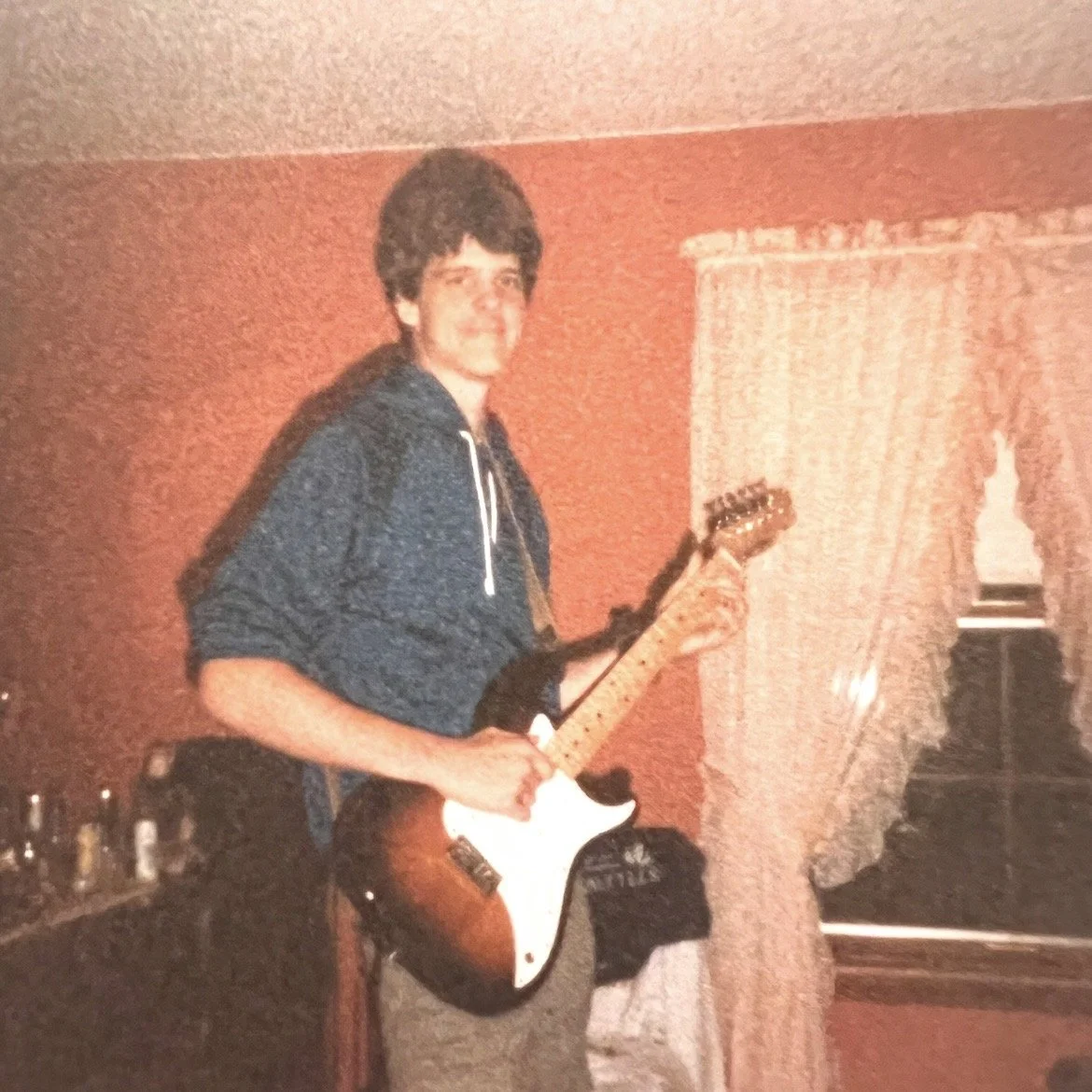
Control yourselves, ladies.
To save you from having to do the math, I got my first guitar on January 4th, 1986. I was a fifteen-year-old in the rural midwestern US. Aside from a bizarre and precocious obsession with 30s and 40s big band Swing a few years earlier, the main conduits to music in my isolated, MTV-less life were the two area radio stations powerful enough to reach the barren wastelands I called home. One was Z93, which peddled Top 40 Pop. The other was WTUE. ‘TUE focused on the “Classic Rock” of the 60s and 70s, while liberally sprinkling in the contemporary hard rock and heavy metal that was enjoying its heyday in that neck of the woods. Being a teenage boy with a thirst for bombast and a surplus of testosterone (and no other responsible way of using either), it’s no surprise that I steered clear of the lighter pop of Z93 and gravitated to the other option. I was a ‘TUE kid.
It was a halcyon time for excess, the 80s were, and the world of hard rock distilled the times to a tee. Nearly every band was a whirlwind of color and spandex, and the Aqua Net budgets alone dwarfed the entire recording and touring budgets of your average modern-day group. But even more crucially, every band needed a hot shot guitar slinger. Guitar solos were epic displays of virtuosity and acrobatics, meant to drop jaws (and other things), and may merciful God help you on the Billboard charts if your song didn’t have one. It was the Age of Shred. Edward Van Halen, Yngwie Malmsteen, and Randy Rhoads were the Father, the Son, and the Holy Ghost.
I confess to having a soft spot for a lot of that music to this day; after all, the stuff you listen to in your teen years will always stick with you and, as a young pup trying to crack the code of what a guitar could do, all that flash was a good motivator to practice. But on an artistic level, most of that stuff was empty calories, a big bowl of Fruity Pebbles for breakfast that leaves you exhausted and drained in fourth-period Algebra once the sugar wears off. The lyrics were, by and large, afterthoughts- vapid and vacant, not particularly geared for introspection. I realize now that this was clearly a byproduct of the copious amounts of high-quality Peruvian marching powder consumed by the music business at the time. Who cares about the Human Condition when you’re gakked to the gills? I’m not saying there’s not a place for celebratory good-time tuneage, but making it a staple of your diet is akin to living on Mountain Dew and Funyuns. It’s just not sustainable. You gotta eat a salad every now and then.
So, what happened to me? Metaphorically speaking, I learned to like salad. I got older. My tastes changed. I played in a lot of bands. And I started noticing that delicious alchemy that occurs when players change the focus from trying to impress to trying to connect, with one another as well as the listener.
Most of my favorite bands feel like one big collective instrument in and of themselves, each member providing a simple, vital piece of the puzzle that meshes with what the others are playing and makes something undeniably, viscerally communal. The Rolling Stones are the first group that comes to mind. I know you’ve heard it thousands of times already, but listen to “Jumpin’ Jack Flash”. Or “Gimme Shelter”. Those songs are groove machines, churning away, no one’s playing anything particularly difficult, but take any single element out, and the whole thing would fall apart, or at least be a shadow of itself. Africa 70, fronted by the legendary Nigerian bandleader Fela Kuti is another example. Hell, James Brown made The Groove his entire life’s work.
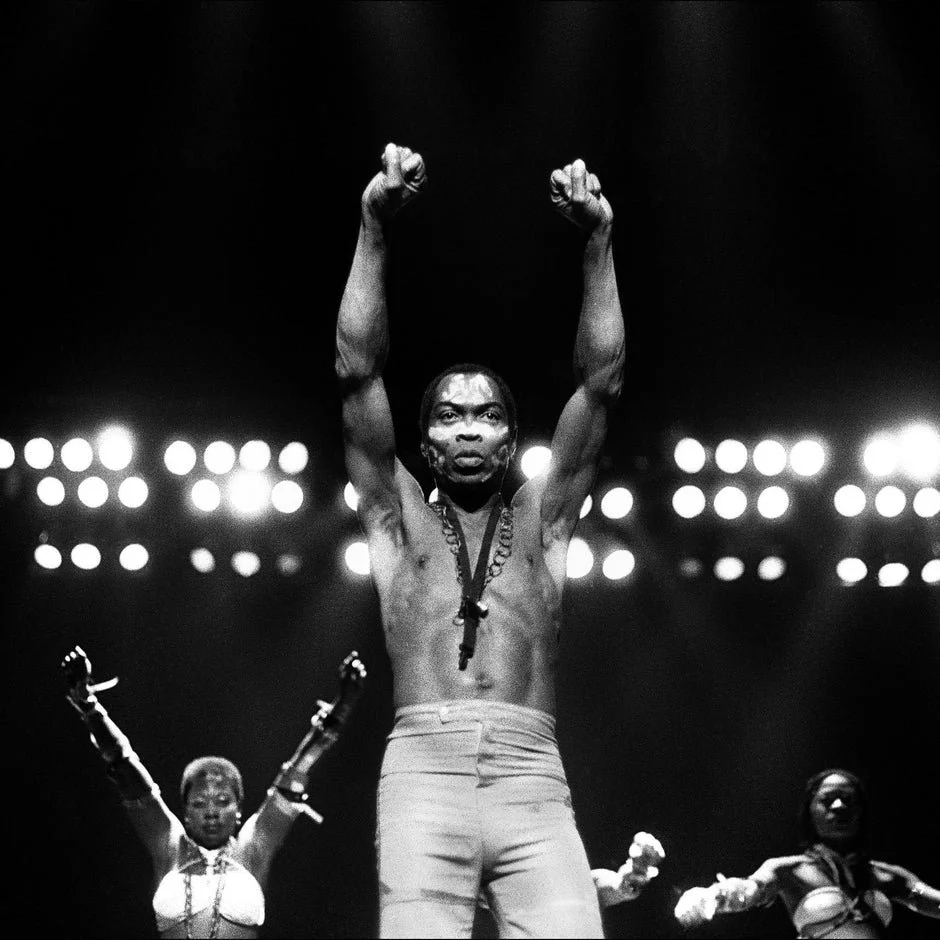
The mighty Fela Anikúlápó Kuti. Approximately 3000% cooler than that kid in the first photo.
In each of those examples, the band members are listening to one another- having a conversation. And that’s a skill that doesn’t come as easily to musicians– especially technically-gifted ones– as one might assume.There’s a temptation to throw your entire education into a performance, but that becomes about as fun to the other musicians as talking to somebody who, instead of processing what you’re telling them, is planning what they’re going to say next when you finally shut up. The longer I do this, the more I become aware that the most essential pieces of gear I have in my rig are the two holes on either side of my head.
When everybody’s listening and the performance becomes a conversation instead of a lecture, the veil is pierced, and the Door opens. Sound becomes music. The audience can always tell when it’s truly cooking. They’ll react accordingly, and the resulting self-sustaining feedback loop is a wondrous, magical thing.
To that point…
I’d rather be known as a good musician than as a good guitarist.
This all makes me think of two of the all-time bonafide wiggy-brilliant eccentrics in modern music: Thelonious Monk, the beloved and deeply quirky jazz composer, pianist and bandleader (to whom the name of my blog gives an affectionate nod and wink), and Don Van Vliet, a childhood friend of Frank Zappa’s who went on to dub himself Captain Beefheart and lead his Magic Band into some truly mindbending places. Monk’s Rules were jotted down by his sax player, Steve Lacy, at a session and, while some are absolute head scratchers (guess you had to be there), some are actually quite profound. Captain Beefheart’s Ten Commandments are technically aimed at guitarists joining his band, but most of the points can be adapted to other instruments. I’m attaching both lists here for your entertainment and education.
By the way, they're not just for musicians, either. I submit to you the notion that if we all listened more than we spoke, kept our need to show off in check, and embraced the power of substance and connection over artifice, the world might be in a better place.
LET’S LIFT THE BAND STAND.
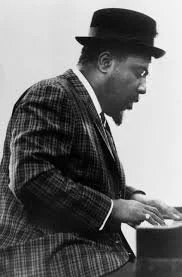
THELONIOUS MONK’S 25 TIPS FOR MUSICIANS:
Just because you’re not a drummer, doesn’t mean that you don’t have to keep time.
Pat your foot and sing the melody in your head when you play.
Stop playing all that bullshit, those weird notes, play the melody!
Make the drummer sound good.
Discrimination is important.
You’ve got to dig it to dig it, you dig?
All reet!
Always know
It must be always night, otherwise they wouldn’t need the lights.
Let’s lift the band stand!!
I want to avoid the hecklers.
Don’t play the piano part, I am playing that. Don’t listen to me, I am supposed to be accompanying you!
The inside of the tune (the bridge) is the part that makes the outside sound good.
Don’t play everything (or everytime); let some things go by. Some music just imagined.
What you don’t play can be more important than what you do play.
A note can be small as a pin or as big as the world, it depends on your imagination.
Stay in shape! Sometimes a musician waits for a gig & when it comes, he’s out of shape & can’t make it.
When you are swinging, swing some more!
(What should we wear tonight?) Sharp as possible!
Always leave them wanting more.
Don’t sound anybody for a gig, just be on the scene.
Those pieces were written so as to have something to play & to get cats interested enough to come to rehearsal!
You’ve got it! If you don’t want to play, tell a joke or dance, but in any case, you got it! (to a drummer who didn’t want to solo).
Whatever you think can’t be done, somebody will come along & do it. A genius is the one most like himself.
They tried to get me to hate white people, but someone would always come along & spoil it.
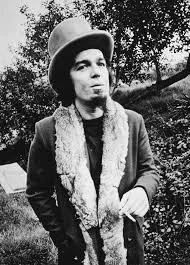
CAPTAIN BEEFHEART’S TEN COMMANDMENTS OF GUITAR
1. Listen to the birds
“That’s where all the music comes from. Birds know everything about how it should sound and where that sound should come from. And watch hummingbirds. They fly really fast, but a lot of times they aren’t going anywhere.”
2. Your guitar is not really a guitar
“Your guitar is a divining rod. Use it to find spirits in the other world and bring them over. A guitar is also a fishing rod. If you’re good, you’ll land a big one.”
3. Practice in front of a bush
“Wait until the moon is out, then go outside, eat a multi-grained bread and play your guitar to a bush. If the bush doesn’t shake, eat another piece of bread.”
4. Walk with the devil
“Old Delta blues players referred to guitar amplifiers as the ‘devil box’. And they were right. You have to be an equal opportunity employer in terms of who you’re bringing over from the other side. Electricity attracts devils and demons.
“Other instruments attract other spirits. An acoustic guitar attracts Casper. A mandolin attracts Wendy. But an electric guitar attracts Beelzebub.”
5. If you’re guilty of thinking, you’re out
“If your brain is part of the process, you’re missing it. You should play like a drowning man, struggling to reach shore. If you can trap that feeling, then you have something that is fur bearing.”
6. Never point your guitar at anyone
“Your instrument has more clout than lightning. Just hit a big chord then run outside to hear it. But make sure you are not standing in an open field.”
7. Always carry a church key
“That’s your key-man clause. Like One String Sam. He’s one. He was a Detroit street musician who played in the fifties on a homemade instrument.
His song ‘I Need a Hundred Dollars’ is warm pie. Another key to the church is Hubert Sumlin, Howlin’ Wolf’s guitar player. He just stands there like the Statue of Liberty — making you want to look up her dress the whole time to see how he’s doing it.”
8. Don’t wipe the sweat off your instrument
“You need that stink on there. Then you have to get that stink onto your music.”
9. Keep your guitar in a dark place
“When you’re not playing your guitar, cover it and keep it in a dark place. If you don’t play your guitar for more than a day, be sure you put a saucer of water in with it.”
10. You gotta have a hood for your engine.
“Keep that hat on. A hat is a pressure cooker. If you have a roof on your house, the hot air can’t escape. Even a lima bean has to have a piece of wet paper around it to make it grow.”