
SAFE TRAVELS, MR. DOUGLAS

© Jim Steinfeldt/Michael Ochs Archives/Getty Images
This past Monday, May 11, was my birthday. I turned 56 (?!?!), and I was planning on writing about that for this week’s blog post, waxing philosophical and maudlin about…well, something or other, with the wisdom and gravitas I have just acquired from cresting the summit of my mid-50s and beginning to ride the brakes all the way down to 60. I may still do that at some point soon. Nah, let’s face it- I will do that at some point soon; I’ve met me, after all, and know how my brain works. But today I’m writing about something, someone, else, instead.
I want to talk to you about Jack Douglas.
Do you know that name? You might. If you’re reading this, there’s a good chance that Music is important to you (my main demographic, bless your nerdy little hearts). Suffice to say, if his name doesn’t ring a bell, his legacy will. Jack Douglas produced, mixed, and/or engineered a host of albums that occupy sacred spots in my heart, for a pretty goddamned heavy list of clients: The New York Dolls.Patti Smith.Cheap Trick.Alice Cooper. Those glorious, drug-fugged albums of Aerosmith’s 70s golden era, those bangers that walk a weaving but steady line encompassing menace, humor, louche charm, and a surprising level of musical sophistication, all at the same time? Jack Douglas produced all of ‘em,from their self-titled debut through Draw the Line- a creative run that rivals the Stones’ hot streak between Beggar’s Banquet and Goat’s Head Soup in terms of creative decadence and myth-building. I could, and may well yet, write a post about the magic that lies within the grooves of “Last Child” or “No More, No More” or “You See Me Crying”, and Mr. Douglas played a big part in said magic.
Perhaps most crucially, Douglas had a fruitful association with John Lennon, engineering Lennon’s Imagine album and producing John and Yoko’s Double Fantasy. In fact, he was at the Record Plant, preparing to run a mixing session for Yoko’s “Walking on Thin Ice” (featuring Lennon on lead guitar), on the night of December 8, 1980. John and Yoko were waiting outside the Dakota Hotel for the limo to take them to the studio when Mark David Chapman pumped four hollow-point bullets into Lennon’s back, cancelling the session and silencing one of the most important voices of the 20th Century forever.
And now Jack Douglas is gone, as well. He passed away Monday, on my birthday, of complications from lymphoma. He was 80 years old. A huge loss to the Music World.
It’s hitting me harder than I expected it to, for a couple of reasons. Firstly, I had been unaware of his illness. Lymphoma has taken a number of significant people in my life from me, and now it’s claimed another. Secondly, there’s an extra, personal aspect to his passing, because Jack Douglas and I (in a series of events that I still have trouble wrapping my mind around) had made plans to work together.
This story takes place, as many of my blog posts have, in the Bay Area in early 2020. As I have mentioned here before, my wife and I had just packed up our lives and moved from Ohio to Sunnyvale, California, and I was starting the next phase of my musical life as a solo artist in tentative, hesitant steps. My de facto manager, number one fan, and dear friend Jack Piatt (there’s some good juju in the name “Jack” for me, it seems), had recently told me of his long-held plans; now that we were on the same coast, he intended to put his astonishing rolodex of contacts to work and get the solo album he had always wanted out of me. I was game. I had been recording crude GarageBand demos of some new tunes and sharing them with him. There was one track in particular that he had especially taken a shine to. “Good Enough” was a fragile little slice of honesty, written for a friend who was going through hard times (and also as a little pep talk for myself, frankly). It’s a very personal song, one I don’t play live very often. The opening line is… a lot, and I’m always a little concerned about it being taken out of context:
Suicidal
Ideation
Face the monster
Beat him down
With medication
And better angels
And good intentions
And mediocre salesmen
Pushing bad inventions
Oh hear me now
Can I help you? Tell me how
Can you tell me what I’m s’posed to do
If my best ain’t good enough
My best ain’t good enough for you
Livin’ sorry
Barely sleepin’
Runnin’ from the sunset
As the colors deepen
From red to purple
And cool to colder
The bony hands
Of unmade plans
Upon your shoulder
Oh hear me now
Can I help you? Tell me how
I’m not tryin’ to tell you what to do
My best ain’t good enough
It ain’t good enough for you
Spinnin’ circles
Gettin’ dizzy
The left hand knows enough
To keep the right one busy
Chase the rabbit
Becomes a habit
Not much joy around these days
If you see some grab it
And hold on tight
All this pain is worth the fight
You’ve got what it takes to see it through
Your best is good enough
It’s good enough
Your best is good enough for you
Oof. Anyway.
One of Jack’s recent film projects had put him in contact with Jack Douglas. And, since Jack (Piatt) is a perpetual lifter-upper of others, he played the demo for Jack (Douglas). Mr. Douglas, while still very active in the Industry, had long since reached a point where he had stopped saying “yes” to projects that didn’t resonate with him. He loved “Good Enough” and told Jack he was interested in producing it.
I can remember where I was when Jack P called me with the news; it was one of those life events where you try to take in as much detail as possible, to add to the Mental Highlight Reel and pull out when you need a pick-me-up. It was a bright, clear late Winter day. I was on Iowa Street in downtown Sunnyvale, between Murphy and Taafe, next to the Target, taking a walk. Jack P told me to expect a phone call from Jack D later that day.
That phone call was a blur, and I was so gobsmacked to be talking to a bona fide legend that I was sort of floating outside my body during it. I thanked him for all the music that had touched my life so deeply- I do remember that much. We exchanged pleasantries for a bit and then he got down to business, asking me what the song was about. I told him basically what I just wrote above.
“So, it’s the truth,” he said.
“Yeah.”
He then told me about a conversation he’d once had with John Lennon. At some point during a session, he turned to Lennon and asked him, point blank, “So, John, how do you do it? How do you write these songs?”
Lennon replied, in his Liverpudlian drawl, “You just tell the truth and make it rhyme.”
Tell the truth and make it rhyme.
Fuuuuuuck.
Jack Douglas, channeling John Lennon, had just given me a mission statement for the rest of my creative life.
And then the conversation took an even weirder turn.
“You’re in San Francisco, right?”
“Well, the Bay Area, yeah. Sunnyvale, to be exact.”
“My son, Colin, is going to be the musical director for a Suzi Quatro show up in Marin. There’s a film festival happening up there in March, and the Suzi Quatro documentary is going to be featured. Suzi’s going to do a short set at the festival and Colin’s looking for a band. You want to play guitar? I’ll give him your number.”
I had woken up that morning with no other intentions beyond taking a little walk, maybe working on some new songs. By that evening, I had talked to Jack Fucking Douglas about a recording session and picked up a gig playing guitar for Leather Tuscadero herself.
Strange days, indeed. Most peculiar, Mama.
Jack and I agreed to keep in touch about the recording session, and Colin, true to Jack’s word, reached out about the Suzi Quatro gig. I was getting ready to fly back to Ohio for a Shrug gig in early March. I remember sitting in the concourse at Minneapolis Airport returning a message from Colin. This new virus Covid-19 was starting to make the rounds and it looked kind of serious. The film festival might be put on hold. He’d keep me posted.
You know how the story plays out from there.
I flew back to California after the Shrug gig on a plane that felt like the last chopper out of Saigon. The film festival got scrubbed, and the recording session with Jack was back-burnered until things got back to “normal”. Weeks became months became years. My studio date with Jack Douglas, like his session with John and Yoko that fateful December night in 1980, never ended up happening.
For a long time, cooped up and quarantined in that little Sunnyvale apartment, breathing bad news and scrubbing down groceries, I was bitter about the rug being pulled out from under my big break. Time has softened that bitterness, and now I prefer to look at that bizarre turn of events in a different light. I see it now for what it truly was- a galvanizing event. For the first time since I had ventured out of my protective bubble of the Dayton Music Scene, I had the feeling that what I was doing had merit, that I could hang with the Cats in the larger world. Validation. It lit a fire under my ass.
Jack Douglas was very kind to me. He didn’t have to be. The more I hear about the man, the more I realize that was just how he was. He gave me a gift of confidence and, even though we never got to work together, that’s good enough for me.
Thank you, Mr. Douglas. For everything. Rest easy.
I’ve added that original sketchy little demo of “Good Enough” to my Soundcloud account. You can listen to it here, if you want.
BUILDING A HOME
1972: A blond 2-year-old toddler, chubby from baby fat, is in the tub, being bathed by his father. The scent of Johnson & Johnson’s No More Tears shampoo fills the small bathroom; the bar of Ivory soap bobs in the choppy water amidst a small fleet of toy boats. The father, who seemingly knows thousands of songs, is currently serenading the boy with a mutual favorite of theirs, a tune already nearly 70 years old even then:
Oh, the bulldog on the bank
And the bullfrog in the pool
Oh, the bulldog on the bank
And the bullfrog in the pool
Oh, the bulldog on the bank
And the bullfrog in the pool
The bulldog called the bullfrog
A green old water fool
Singing Tra la la la lala la lideeoh
Singing Tra la la la lala la lideeoh
Singing Tra la la la lala
Singing Tra la la la lala
Tra la lala, tra la lala
Tra lala lideeoh
Oh, the bulldog stooped to catch him
And the snapper caught his paw
Oh, the bulldog stooped to catch him
And the snapper caught his paw
Oh, the bulldog stooped to catch him
And the snapper caught his paw
The pollywog died a-laughing
To see him wag his jaw
Singing Tra la la la lala la lideeoh
Singing Tra la la la lala la lideeoh
Singing Tra la la la lala
Singing Tra la la la lala
Tra la lala, tra la lala
Tra lala lideeoh
Said the bulldog to the bullfrog,
“Oh, what’ll you have to drink?”
Said the bulldog to the bullfrog,
“Oh, what’ll you have to drink?”
Said the bulldog to the bullfrog
“Oh, what’ll you have to drink?”
“Well, since you are so very kind,
I’ll have a bottle of ink”
That last line is the big payoff; the little boy has been waiting excitedly for it and, as always, laughs uproariously at the absurdity of a frog drinking ink.
The surveyors arrive, set up their equipment, and begin measuring.
1974: A 4-year-old boy, still towheaded, but scrawnier now, due largely to his dedicated regimen of Big Wheel riding and running full speed whenever possible, sits at a table at Cassano’s Pizza in Troy, Ohio. He’s there with his two junior-high-aged cousins and a few of their friends. They look like grownups to him, all flares and perms and denim jackets, and he regards them with the awe unique to little kids who feel as if they’ll be little forever. The jukebox is playing: “The Night Chicago Died”, by Paper Lace. The song is about a fictionalized showdown between Al Capone’s gang and the Chicago Police Department, but the boy, being four, doesn’t get the references. In the noise of the room and the din of the definitely-not-adult teens, he conflates the lyrics into a tale of how the narrator’s mother died, which strikes the boy as very sad subject matter for such a happy-sounding song. He may be confused, but he’s also transfixed.
Lumbering yellow excavators scoop up mouthfuls of earth, emptying them into a parade of dump trucks.
1976: A Kindergartner, feverishly fascinated by Happy Days– The Fonz in particular– is given a battered and scratched stack of 45s by his mother; they had belonged to her and her sister, the boy’s aunt, when they were girls. The boy plays them on his little portable record player, and enjoys almost all of them, but one song in particular grabs him and won’t let go: Elvis Presley’s “All Shook Up”. He plays it over and over, obsessed. The boy has never seen a photo of Elvis, but he’s sure he looks just like Fonzie. His imagination is surprisingly accurate.
Forms are placed. A lattice of rebar. The foundation is poured.
1980: The boy is 10 now. The hair has now turned fully brown, hugging his head in a bowlcut, and he’s as thin as a whisper. The boy and his sister had recently gotten their first portable cassette tape recorder, and their Aunt (the same one who had shared original ownership of that crucial stack of 45s) has given him a Christmas present: a dubbed cassette of selected songs from her old Beach Boys records: Beach Boys Concert. All Summer Long. Shut Down, Vol. 2. That tape (the first of countless mix tapes in his life) will provide the soundtrack to hours upon hours in the basement, at his little workbench, in paint-festooned jeans and hand-me-down MUHS Bulldogs sweatshirt, building airplane models, inadvertently learning how to sing harmonies.
The first truckloads of lumber are dropped off and sit in the churned mud, bound by steel strapping, oozing sap, waiting.
1982: We’re back in a pizza joint. This time it’s Godfather’s in Piqua, Ohio, the site of many Friday night family dinners. The boy waits in a dark alcove for the pizza to arrive, captured by the pale light of an Asteroids game. He’s no good at video games, and quickly burns through the ration of quarters his mom gave him, but he lingers in the tiny arcade as the jukebox pumps out little audio postcards from an exotic place, foreign to his Beach Boys, Smothers Brothers, and Kingston Trio-tuned ears: Joan Jett & the Blackhearts’ “I Love Rock & Roll”. Foreigner’s “Waiting For a Girl Like You”. Rush’s “Tom Sawyer”. The Police’s “Every Little Thing She Does is Magic”. Shortly after, he gets his first clock radio- his passport to AOR and the Top 40. When the onset of adolescence deals him hands he’s ill-equipped to play, he retreats to his room, flops on the bed, and little microdose hits of Styx and the Rolling Stones and Stevie Nicks and AC/DC take him to a place where he’s effortlessly cool and always knows what to say and how to act.
Framing begins. Joists and studs. Bottom plates. Top plates. The skeleton starts to take shape.
1983: The boy is in Middle School Music class. The teacher, Mr. Stitz, is a slight, bug-eyed, balding, allergy-plagued little man, the archetypal geek from all outward physical appearances. But Mr. Stitz contains multitudes. Mr. Stitz is hip. Mr. Stitz plays the class “Several Species of Small, Furry Animals Gathered Together in a Cave and Grooving with a Pict”, from Pink Floyd’s 1969 double album Ummagumma. The boy’s mind is blown, and he talks his parents into getting him his own copy of the record (in retrospect, the weirdest possible entry point into Pink Floyd’s catalog). The opening track, a live version of “Astronomy Domine”, melts down the shards that “Several Species…” created in the boy’s mind and sculpts them into an entirely new way of looking at music.
A stairway is framed in, leading to a whole other level.
1985: The boy, now 15, his lanky frame wrapped improbably around his childhood bike, is riding down the road to his first real job- mowing his neighbors’ vineyard. The property is big enough that he’s able to mow every day; by the time he finishes, the area he started with needs mowed again. To pass the time, he sticks the detachable earpieces to his Walkman into his shooting-range hearing protectors and spends hours and countless sets of AA batteries listening to his small collection of cassettes- small, but steadily growing, thanks to his new source of disposable income. Jimi Hendrix’s Smash Hits. K-Tel’s The Story of the Stones. Creedence Clearwater Revival’s Chronicle. Joe Walsh’s The Confessor. Van Halen’s Diver Down (the entire Roth-era Van Halen catalog, really). Soon, he will splurge on The Beatles’ White Album and spend entire months living inside it, memorizing every single sound on that sprawling masterpiece.
The window openings are cut out of the plywood paneling, letting the light in.
Around this time, a common rite of passage for those in the throes of unfocused teenage angst: the boy discovers The Doors.
The doors are (literally and figuratively) installed.
1986: The boy, still alarmingly skinny and trying hard to grow his hair out, has a driver’s license now, opening his world up to the heavy metal concerts rotating through Hara Arena. His first is the night before Thanksgiving: Yngwie Malmsteen’s Rising Force, with support by Saxon and Black ‘n’ Blue. It’s the first time he smells weed. It’s the first time his ears will ring the following day. It will not, by any means, be the last.
The roofers lay down the tar paper and shingles. Things are under roof now. Shelter from the storm.
1988: The boy graduates High School and starts College. CCAD, the Columbus College of Art and Design (one of many Columbus schools living perpetually in the shadow of THE Ohio State University). A den of freaks and misfits. After a relatively white-bread rural heartland upbringing, it’s the boy’s first exposure to edgier characters. He’s introduced to “College Rock”: R.E.M. and Camper Van Beethoven start competing with Iron Maiden and Deep Purple for airtime on his boombox. Punk Rock rears its head and captivates him.
The utilities go in. Plumbers do their thing. Electricians run their wiring. The lights come on.
1991: Art career abandoned, the boy is now (legally and in theory, at least) a man, at 21. He’s been playing guitar for a few years now. Hooked. He gets a job at a mall record store. By now, he is an absolute sponge, soaking up music from all directions, adding Public Enemy and Fugazi and John Coltrane and the Clash and Bach to the gumbo. The hair is very long now. He’s a Seattleite at heart, stuck in Ohio. He sees Jane’s Addiction in the Spring, at the same arena he had come of age in. A blistering set, a communal bacchanal. During the encore, Perry Farrell thanks the crowd for its energy and delivers the benediction, saying, “It’s gonna be a good summer.” It is.
Insulation is added. Protection from the outside world. The drywall is hung and mudded. Things are starting to really come together.
1995: The kid is 25, now firmly entrenched in the local music scene. The previous fall he’d had his molecules rearranged by Jeff Buckley’s Grace, an album unlike anything else he’d ever heard, but at the same time strangely familiar, tying together Led Zeppelin and Nina Simone and Benjamin Britten and Joni Mitchell in a way that somehow works perfectly. In May he gets his chance to see Buckley live, at Bogart’s in Cincinnati, and learns what true charisma is. From the moment Jeff walks from the wings in his white V-neck and Drugstore Cowboy leather jacket, dragging on his cigarette, it is impossible to take one’s eyes off of him. It’s an unattainable blueprint, but one the kid tries his damndest to follow for the next several years, at least until he gets a better idea of who he actually is.
The facade goes up.
2003: The little boy is 32 now. No longer skinny, the first hints of gray starting to creep into the short-in-back/long in-front cut he’s sporting now- a physical manifestation of a vague, growing weight he’s carrying. Adulthood, the struggles of reconciling what he wants to do with what he has to do, who he is and what he should be. On the surface, everything’s going pretty OK, but inside’s a different story. He’s never been a stranger to occasional melancholy, not even as a young kid, but lately that inner cloud has become heavier and darker, and more frequent. One gray Saturday in the dead of winter he goes for a long, aimless drive to either clear the murk from his head or, failing that, to wallow in it. He heads south from Dayton and winds up in Fairfield, at a vast shopping mall. He wanders for a bit and, as usual, finds a record store. He ends up buying a CD he recently read a glowing review of, Bright Eyes’ Lifted or the Story Is In the Soil, Keep Your Ear to the Ground. The boy takes the long way home, though the snow-covered stubble of harvested corn fields. It’s one of those perfect moments, where the right mood aligns with the right music in the right setting. Conor Oberst, this goddamned 22-year-old kid from Nebraska, has managed to encapsulate everything the 32-year-old manchild was going through at the time with those songs, delivered like a combination of Bob Dylan and Brian Wilson, filtered through a midwestern lens. Those tracks burrow deep into him, and the truth in them exposes the lack of real truth in his own life and music. It’s jarring, and sad, and inspiring, all at the same time- a satori, a much-needed spiritual kick in the head, and it motivates him to recommit to true self-expression. By the time the album is done and he gets back home, he feels a lot better.
The house is still relatively new, but the first renovation is already overdue. Out with the old, in with the new.
All these little steps and snapshots have resulted in a home for the boy. Some people have Church to provide their compass, their sanctuary from troubles, a place to retreat to and assess and reassess their place in the world. Music has always been- and always will be- his. He’s redecorated the place from time to time. He’s repainted, switched out the furniture, and added some rooms over the years- Reggae, Cosmic Country, West African Desert Blues, Gypsy Jazz…but the bones are still there, and they’re good, and he can’t see himself moving anytime soon.
It’s a blustery day. Rain lashes the siding and streams down the windows, but it’s warm and dry inside. The boy is 55. He could lose a few pounds. His mop of hair is more silver than brown these days. He gingerly puts a fresh record on the turntable, and turns the rest of the boys he’s been.
“There’s no place like home. Now check this one out.”
CLIFF DIVING WITH CARL SPACKLER
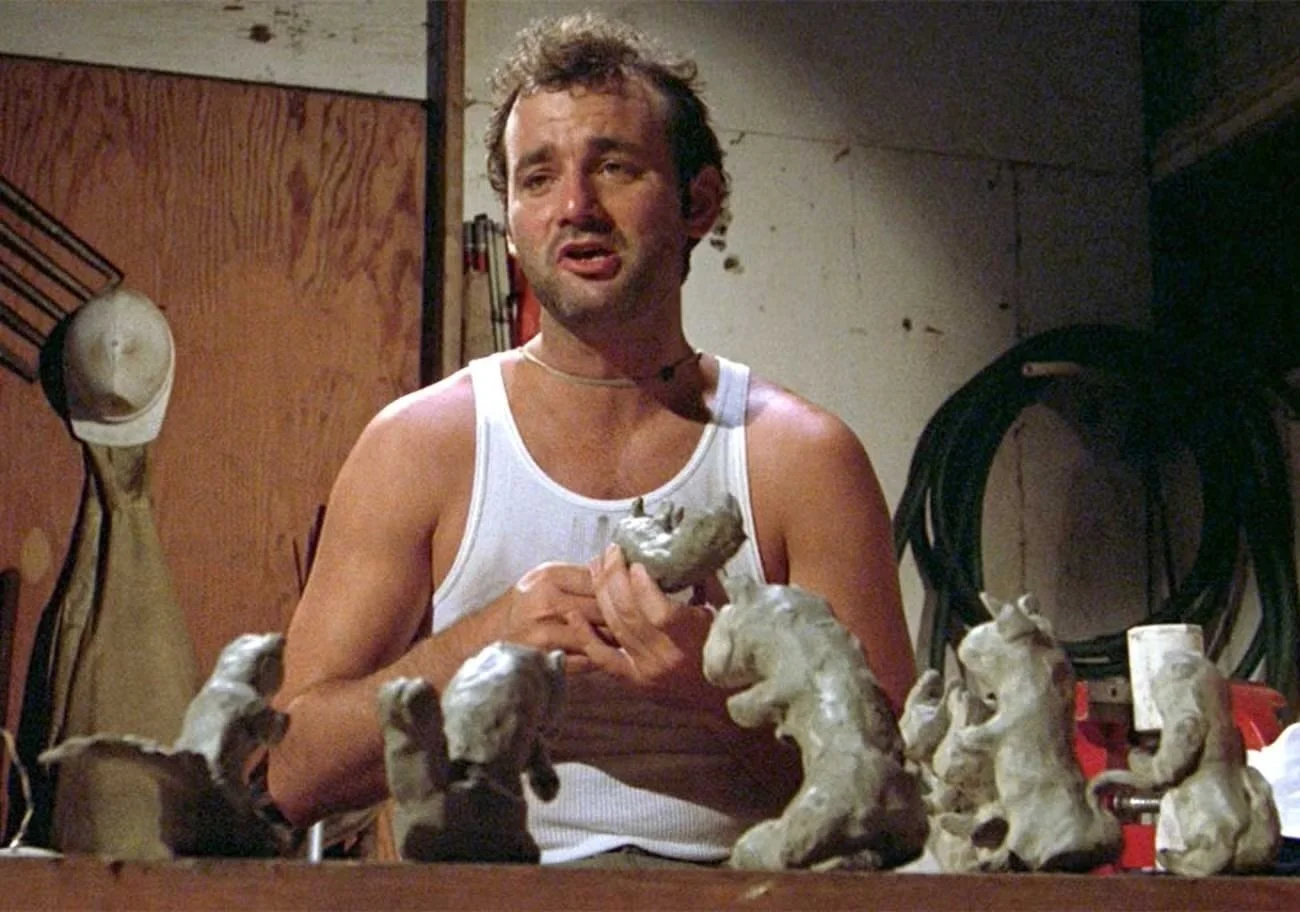
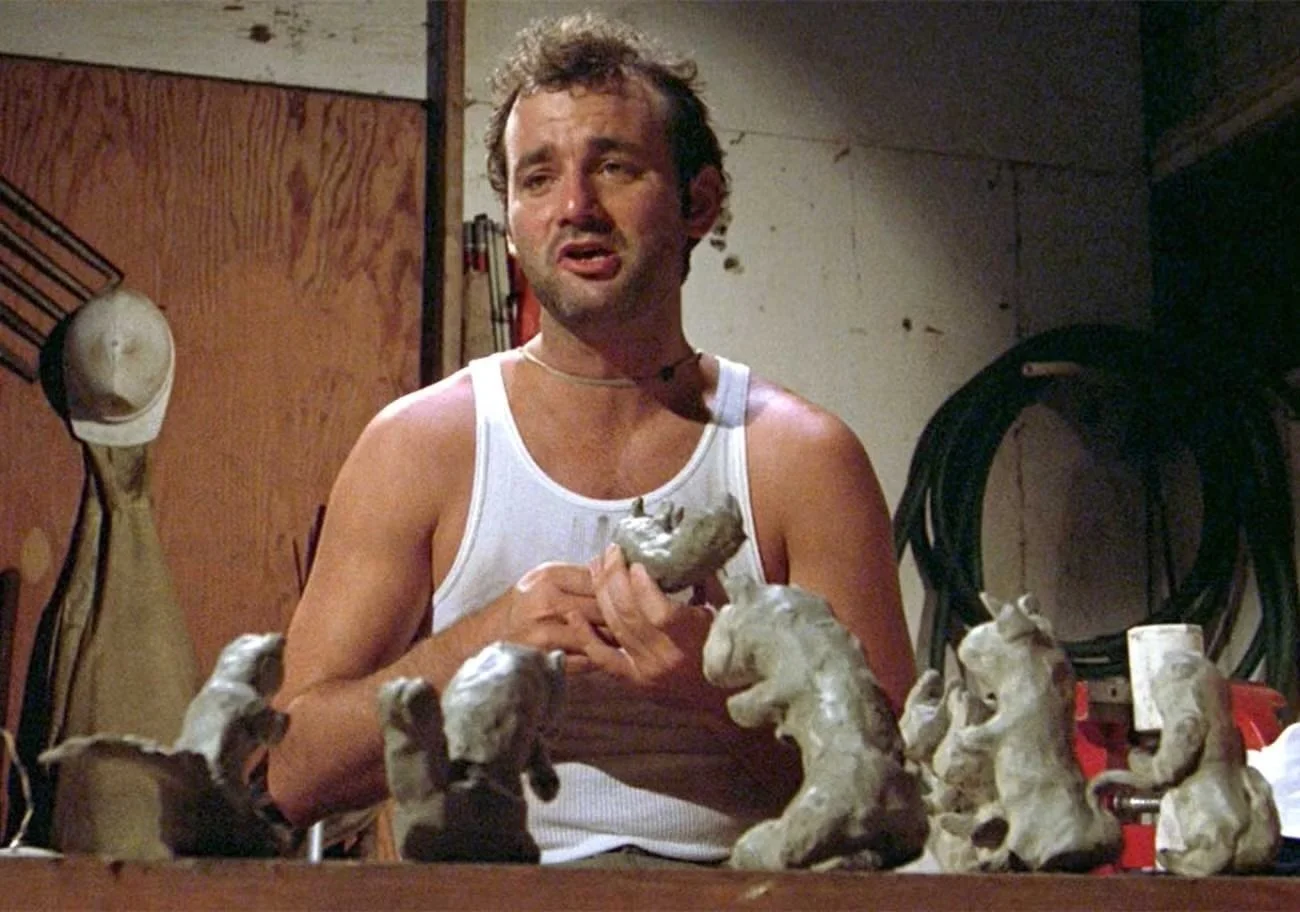
It’s early Tuesday morning and, as is my wont lately, I’m sitting in my beloved local coffeehouse, staring down the yawning white maw of Google Docs on my laptop screen. Wait. Can yawning maws be white? I feel like yawning maws historically tend to be darker and more shadow-filled. Let me try again. I’m staring into the implacable Easter Island visage of an empty Google Doc. Many writers better than I will ever be have waxed poetic about the intimidation and possibility of an empty page, so I’ll let them handle that. All I know is that I do this every Tuesday morning, aiming to keep my streak intact. I set out to write a blog post every week and, eleven weeks in, I’ll be damned if I haven’t managed to keep my promise to myself. And you have graciously decided it was worth your time read it. In the words of Carl Spackler in Caddyshack, “So, I’ve got that going for me, which is nice.”
At least half the time, I sit down having no idea what I’ll be writing about here. Last week, I started typing about how much I disliked Smooth Jazz (update: I still do) and somehow ended up writing about the death of my dad (it should be stressed that, whatever my feelings are for Smooth Jazz, I am in no way implying that it was responsible for killing my father). I kind of found a way to tie the two things together. It wasn’t necessarily elegant, but that’s kind of beside the point, really. I just try to move words around until they sound OK together and, if they ring in a coherent fashion, so much the better. Which is nice.
This devil-may-care approach is a fairly low-stakes example of the nascent, developing thrill I’m cultivating of jumping off cliffs. I speak metaphorically here- I’m not going to be hurling myself off the rocks in Acapulco any time soon. I touched on this a few blogs back, when I wrote about my spontaneous decision to take a job in this very coffeehouse as a roaster. Sometimes it’s good to say “yes” to things, and work out the details as you go.
I’ve become addicted to playing music that way, especially; I love the rush of sitting in with someone with zero rehearsal and just seeing where it goes. I’ve been at it long enough to have developed a decent, workable musical vocabulary. I know how to listen. What’s the worst that could happen? Even if it’s a total trainwreck, nobody gets hurt, and the musicians and the audience are left with the adrenaline afterglow of at least an attempt at magic. The longer I do this, the less precious I get about not embarrassing myself. Some time ago I read a quote by David Bowie that really resonated with me:
“If you feel safe in the area you’re working in, you’re not working in the right area.
Always go a little further into the water than you feel you’re capable of being in.
Go a little bit out of your depth.
And when you don’t feel that your feet are quite touching the bottom,
you’re just about in the right place to do something exciting.”
Bowie knew what’s up. Once you get a taste for not being sure if you’re going to stick the landing, it’s really hard to go back to the tried and true.
The coffee’s starting to kick in. Good thing, too, because I walked in here excessively groggy and bleary, the direct result of saying “yes” to something. A couple months back, I was approached by a buddy of mine, a very talented singer/songwriter/guitar slinger with a kick-ass Country Rock power trio. He and the band have some festival dates this summer, and they were considering expanding the lineup to fill out the sound. Was I interested in being the second guitarist? He and his rhythm section are good, kind humans with a strong work ethic. The music, while not 100% in my wheelhouse, is quality stuff- well written, with lots of cool little touches and filigrees. I was flattered and honored to be asked, figured it would be a cool, fun experience and good for my chops so, after about one and a quarter seconds of careful consideration, I told him I was in. They had a big show coming up in June and he sent the charts for the songs. I got to woodshedding on them. Last night was our first rehearsal and, while I can’t say it was perfect (the live arrangements are slightly different from the recorded versions and it was, believe it or not, my first experience using in-ear monitors, so there was bit of a distracting learning curve with that), it went well enough that I was asked if I would play with them at another festival this Friday night.
So I’ve got that going for me, which is nice.
I need to make some adjustments to my pedalboard. I had it dialed in more for traditional Country, and these guys are a quite a bit harder rocking than that onstage- less Dwight Yoakam, more Lynyrd Skynyrd/Allman Brothers. It was a five-hour rehearsal, so I’m stiff and sore, as I often am after long gigs. My wife always credits it to my “jumping around” (delivered in a way that I would consider condescending if it were coming from anyone else; since it’s her, it just makes me laugh), but I think it has more to do with my stance. I’m tall, so I’ve developed a kind of bent-leg crouch to a) look cool (the goal, at least) and b) avoid towering over my bandmates onstage. It’s murder on the knees, but that’s the price we pay for Rock & Roll.
Most importantly, though, my time frame for being off-book on these songs has now been shortened significantly, and I need to walk the razor-thin line of learning the new cues and quirks of the live versions of these songs by the end of the week, but not so much so that I lose the looseness and spontaneity that this band and I both enjoy so much. We might stick the landing, we might not. I’m certainly gonna do my best, but I’m sure it’ll all work out fine, one way or another.
What a glorious house of cards it is, and how lucky I am to get to do it.
Geronimo.
ON HOLD
Thank you for your patience. Your call is important to us.
I’m typing this at the coffee house. Smooth Jazz is playing over the speakers. Kim Waters’ version of “Midnight at the Oasis”, according to Shazam, the song identification app that I would have killed to have access to as a young person, and one that still kind of blows my mind, even though I’m embarrassed to say that I use it as often as not for “Hate Shazamming”, as my wife calls it. It makes me think of an old quote from Nick Cave: “I’m forever near a stereo saying, ‘What the fuck is this garbage?’ And the answer is always the Red Hot Chili Peppers.” In my experience, it’s astonishing how often I’ve asked myself a similar question, only to have Shazam inform me that I’m listening to Black Eyed Peas.
I digress.
As I mentioned, I’m in the coffee house, and Smooth Jazz is playing. One of my least favorite genres of music, truly. The Jazz of privilege. Jazz for people who don’t really like music, but need to have music playing. Jazz with all the rough edges– all the things that make it interesting– sanded off, revarnished and engineered for maximum profit and marketability. The safest Jazz. I feel like I’m watching the Weather Channel. I feel like I’m on hold.
We are experiencing a higher-than-usual volume of calls. A representative will be with you shortly. Thank you for your patience. Please stand by.
I spent a lot of 2025 on hold. Not literally waiting on my phone, but in a hazy, liminal, gray area, an existential waiting room, as it were. I was in a bit of a dry spell, creatively and emotionally; Life was serving up a steady stream of chaos and curve balls, and every time I was on the verge of re-establishing the groove I had enjoyed the year before, something would come up and throw sand in the gears. On top of the general shambolic state of the world tugging at our sleeves, our household went through unemployment, a move, and countless other little paper cuts of setbacks and tribulations.
2025 was a lot.
The biggest upheaval, by far, occurred at the end of July, when my dad, who had been living with dementia for the past decade, took a sudden, dramatic, and confusing turn for the worse. Living across the country, I received the details in a jumble, delivered by my (quite understandably) stressed-out mother and sister and, even now, I’m a bit unclear on the precise details and order of events. The upshot is that, after an episode in the middle of the night, Dad was taken to the ER. A CT scan was administered and nothing major was detected but, having been told that CTs often miss things, it’s my firm, uneducated layman’s belief that Dad had a stroke, because he was never the same man after that. His posture was hunched. He could barely move. His agitation and dementia symptoms intensified dramatically and his speech was often indecipherable. He had seemingly aged a decade overnight. He was transferred to the rehab center at the retirement community, where he would stay, confined to a wheelchair,and unable to care for himself, for the remainder of his life.
I was able to fly home in mid-August and stayed there for about a month and a half. My sister (bless her heart), being local, had been the “boots on the ground” with our mom in the weeks following the episode, and I was glad to be able take the baton from her and help Mom with the day-to-day routine- running errands, assisting her with the T-crossing and I-dotting, machete in hand, hacking through the jungle of paperwork that comes with the final chapters of a loved one’s life.
We spent time with Dad every day, timing our visits for the late morning/early afternoon hours, the sweet spot of lucidity when he would be most present, most like “Dad”, between his morning ordeal of physical therapy and the mid-afternoon onset of Sundowner’s Syndrome. Mom and I would grow to dread that daily 5-minute drive across the complex to Rehab, not knowing what, or who, awaited us.
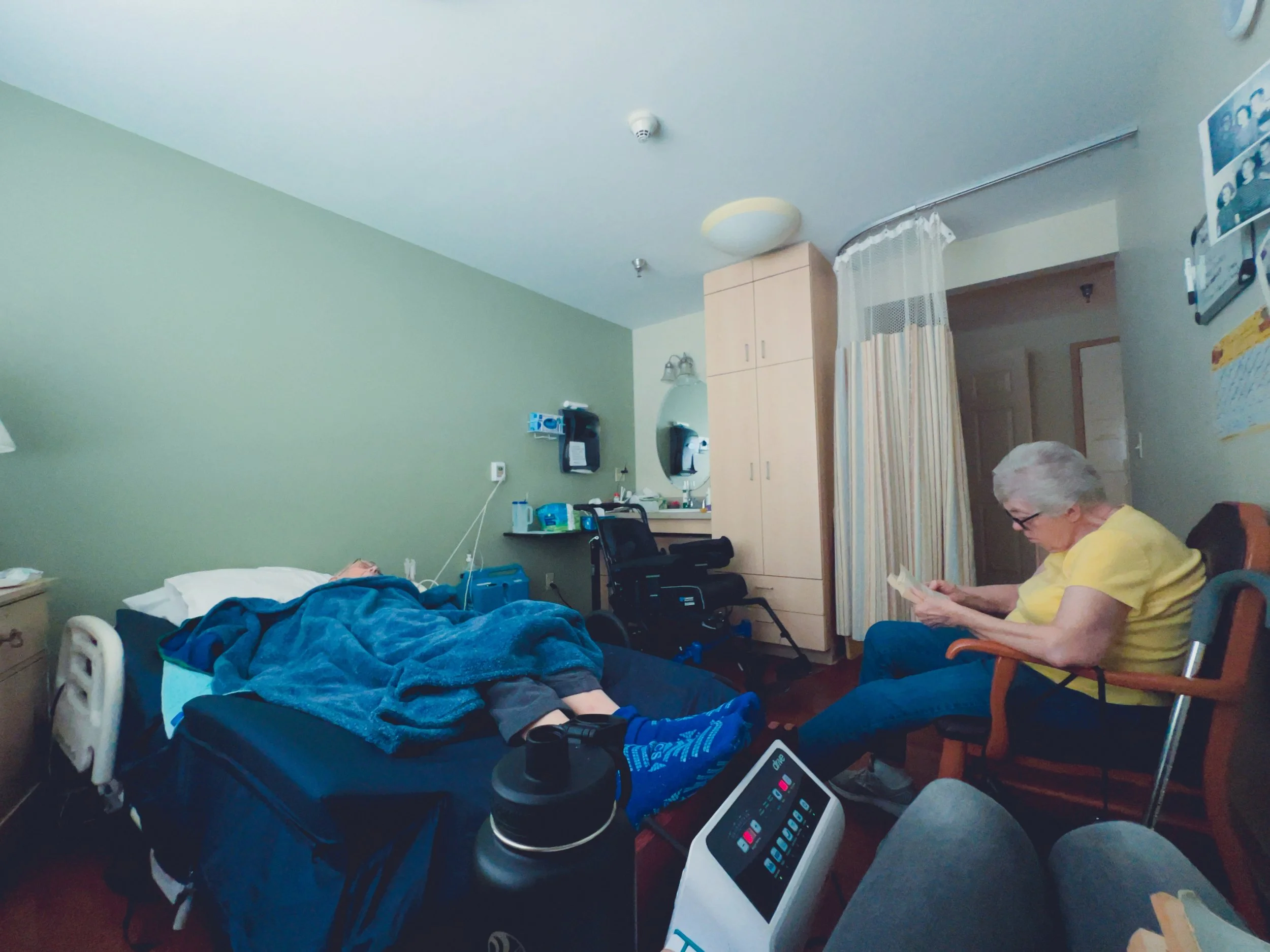
Even in that long, slow, hard decline, there were moments, though. Dad’s old wit would suddenly shine through the fog, and he would say something that made us laugh out loud. I took advantage of one of those flashes of awareness early on. At the time, we were under the impression that he only had days left with us, and he kept saying how sorry he was that he was being such a burden for us. I got right up to his ear and whispered to him that we were going to be alright, everything was in order, that he had a lot of friends and family waiting for him on the Other Side, and that he shouldn’t worry about Mom and Jill and me, and just go ahead and leave when he was ready. I told him how lucky I’d been to be his son, and how much I loved him. My words got through and, of a lifetime of “thank yous” I had received from him, that one was my favorite.
In early October I finally returned to California, and the next few months settled into the familiar routine of daily phone updates and vigil-holding from four time zones away. The situation continued to deteriorate. Hospice got involved. The end of the runway was rapidly approaching, and I flew back again in early December for his last few days. By then he was sleeping most of the time and, when he did say something, it came out in a barely understandable croak. This time it really was a vigil. Mom, Jill, and I were all there, projecting a strange, incongruous informality that somehow felt appropriate; we had always been a close family, and I feel like we had all decided without discussing it that, if Dad was going to check out, he should do it to the sounds of his family chatting and laughing, as we had for decades.
At one point, an unexpected smell filled the room, one different from the usual smells we had grown accustomed to over the previous several months there- pungent, almost fruity. We all noticed it, as did the Hospice nurse on duty. “Is that some sort of disinfectant? Is someone vaping?” The nurse checked the hallway and came back shrugging- nothing amiss. The smell went away as abruptly as it had appeared, and we resumed our conversation. After about ten minutes, Jill looked over at Dad.
“Is he breathing?”
The nurse moved to the bedside. We all stood up and hovered. After what seemed like several minutes of listening and checking vital signs, the nurse announced that Dad had passed.
It was heavy, but somehow different than I expected it to be- relief far outweighed the sadness. I remember the staff (who had grown quite fond of him in spite of the pain in the ass he could be) seeming much more visibly upset than we were. I remember taking the boxes of photos, clothes, and personal effects out to the car. I remember texting Patrice and a few close friends. Jill’s husband Dan met us at Mom’s afterwards (Now just Mom’s, not Mom and Dad’s- weird), and we all went out to dinner at the local Mexican place. I couldn’t stop thinking about that mysterious smell. It was nagging at me. Finally, it clicked.
“Mom, what flavor tobacco did Dad used to smoke?” Dad had been an avid pipe smoker when Jill and I were little kids.
“Cherry.”
That was it. That was the smell. The scenario immediately took shape in my head: at some point, before his heart and lungs had gotten the memo, some part of Dad, the real part, had transitioned to a place– a lobby? A vestibule? A reception area? Something– where his brother, my Uncle Don, 20 years gone, was waiting for him, with that impish grin I remember permanently plastered on his face, offering Dad a pipe. Dad lit it, taking a luxurious, ceremonious first puff.
“Ahhh. FINALLY I can smoke a pipe again.”
“It’s good to see you, Keith. Come on, I’ve got some people I want you to meet.” Uncle Don was the most gregarious man I ever knew; he never met a stranger, and I have no doubt that he’s the heart and soul of any Afterworld there may be.
That little vignette was a comfort to me over the following days leading up to the memorial service. I can’t help but think that the tobacco smell in the room was a smoke signal from the Beyond, Dad letting us know he was at peace.
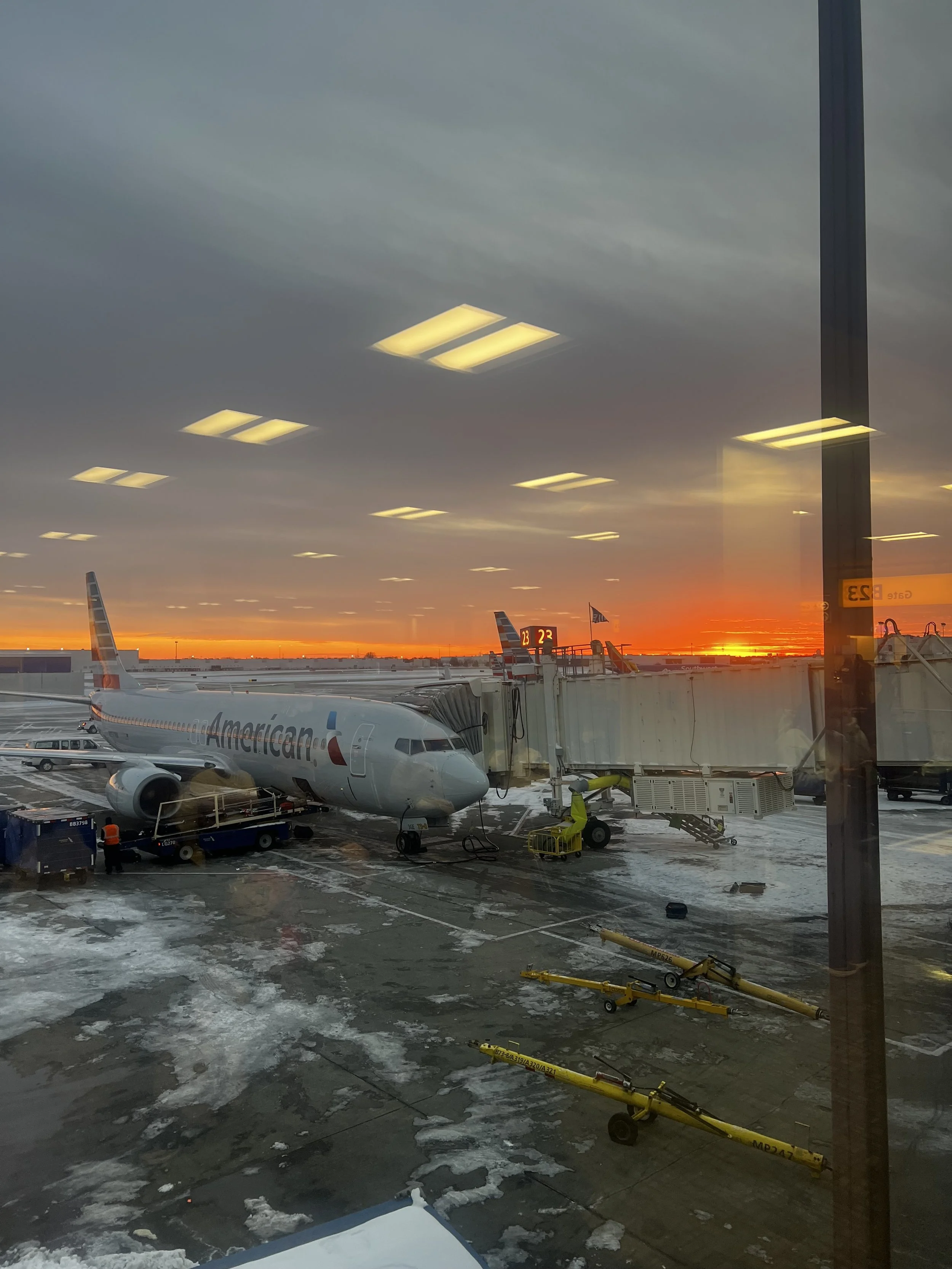
The day after the service, Patrice and I were at John Glenn Airport in Columbus, in line to board our flight to LAX. The entire western sky was painted with the most incredible sunset I’d seen in ages. I’d really like to believe Dad had put in a request for that, a little something to send us on our way home and, between that and the Tobacco Incident, I was preparing myself for a constant string of little synchronicities, little signs from Dad, but the months since then have been notably devoid of them.
I’m on hold again.
I wonder if I’m not tuned in, not looking hard enough. I wonder if I’m looking too hard. There’s not a manual for this kind of thing. I don’t think I’ve actually had a chance to really grieve for my dad yet- there’s been no huge rush of emotion. I initially attributed that to the long period of suffering he went through and the relief of it ending, but now I feel like the other shoe needs to drop, and maybe when that happens the little signs will start showing up.
Another theory of mine is that the issue’s on Dad’s end. He was always a Luddite. He was brilliant and kind, but technology of any sort gave him fits. It’s quite possible that he’s manically pressing buttons on the Cosmic Afterlife Sign remote, to no avail.
“Balls!!! This dad-blamed thing!!!”
Whatever the reason, I’ll stay on hold, Dad. Your call is important to me.
Epilogue
I closed up my laptop, left the coffee house, and walked back home for lunch. Patrice was making hers as I got home and, as she was heading out to the patio, noticed we had a visitor:
Message received, Dad. Thank you.
PELICANS AND PLANES
I’ve been writing songs for a long time. The first one I can remember coming up with was called “Basketball Fever”, which I made up in my head when I was around 7, while I was dribbling a basketball in our basement. It was very short, and very bad, although it did feature a surprisingly syncopated horn arrangement that I probably picked up from a disco-flavored musical number on one of the innumerable celebrity-hosted variety shows that filled the prime-time programming schedules in the 70s. Since “Basketball Fever” was only about 20 seconds long, never recorded, witnessed by no one but me, and- this bears repeating- very bad, I’m relegating it to the “Flukes and Outliers” column in my body of work.
Stung by the lack of chart success for “Basketball Fever”, I took a 13- or 14-year-long sabbatical from songwriting, content to just listen to the radio and my steadily-growing collection of cassette tapes.
As I’ve mentioned before in this blog, I got my first guitar at age 15. It would be a much cooler story arc if I could tell you how I immediately started writing angsty little punk rock manifestos upon learning my first couple of chords, but I’d be lying; for the first handful of years, I devoted all my energy to learning how to play my favorite Classic Rock and Heavy Metal songs. It would be years before it even occurred to me that I could actually write my own songs and, when I did start dipping my toes in those waters, those first tentative attempts were little more than ponderous and derivative guitar riffs with lots of bent notes- more Gray Sabbath than Black, more Soundthicket than Garden, more Jane’s Bad Habit than Addiction. And they contained lyrics that were more about being clever and showing off the big words I knew than communicating any real feelings.
It wouldn’t be until I was around 22 that I first started writing songs I was proud enough of to share in front of people more than once, and even those had their problems. Tim, the first real, steady-gigging original band I was a part of, featured a couple of those tunes, and Dan Clayton (our singer and principal songwriter, blessed with a beautiful, pure voice) encouraged me to sing lead on the songs I brought to the band. The standout in that early batch was “Bed of Rocks”, a fast bit of E minor jangle that owed more than a passing resemblance to early REM. The lyrics? I don’t know, man. Let’s just say I had recently discovered the Beat writers, and leave it at that:
Propane migraine burning fiercely
Ears of those who’s forced to hear
Chairmen choke of suits of sticks
And stones give way to broken bricks
On my bed of rocks
On my bed of rocks
On my bed of rocks again
I know. Very edgy.
Anyway, Dan encouraged me to sing my songs in the band. I had never really sung before and, therefore, didn’t have a clue what my voice sounded actually like. As a result, not knowing what else to do (and like many other singers at the time, much more successful than I), I threw myself headlong into my very best Eddie Vedder imitation. Hey, it was 1993. Thank God video and audio recordings of those early shows are virtually impossible to find. The memory alone makes me wince.
That band led to other bands. That song led to other songs. Over the ensuing years, I started getting a feel for writing, and worked to constantly refine it. I gradually discovered what I sounded like. The songs began to come out more honestly, with less posturing and pretense. Nothing comes from nothing, mind you- we’re all inspired by what others have done before us. The more stuff I was exposed to, the deeper I dug for my influences and the better I got at weaving them into what I do. It’s an ongoing process, one I’ll never finish, but I’m happy and grateful to say that some of the songs I’ve written have resonated with people, which is really all I could ever hope would happen.
As I’ve (also) mentioned before in these blog posts, my wife and I moved to California in 2019, after being lifelong Ohio residents and, for the first time in 26 years of pursuing music, I was…bandless. I had logged lots of solo sets over the decades, but moving to a new part of the world forced my hand and felt like a chance to clean the slate and finally concentrate on creating music under my own name. Any preconceived notions of what “my stuff” should sound like- be it from listeners or just in my head- were put aside, and I started cranking out new songs, inspired by my change of surroundings. Most of the new crop of tunes was a little more Soul-inspired, a bit folkier, quieter and more pensive. The quieter vibe was exacerbated by Covid Lockdown, of course, living in an apartment with neighbors in close proximity, and I’ll probably never know for sure if my music would’ve evolved that way if I hadn’t been cooped up in a tiny apartment. What I do know is that circumstances conveniently sorted my musical output into two main bins: Ohio Songs and California Songs. I keep a master list, and every time I finish a new song I add it to said list. I just checked and, according to my records, there are 93 titles in the California Songs category. Some aren’t very good. A lot are decent. Some I like quite a bit. As it should be.
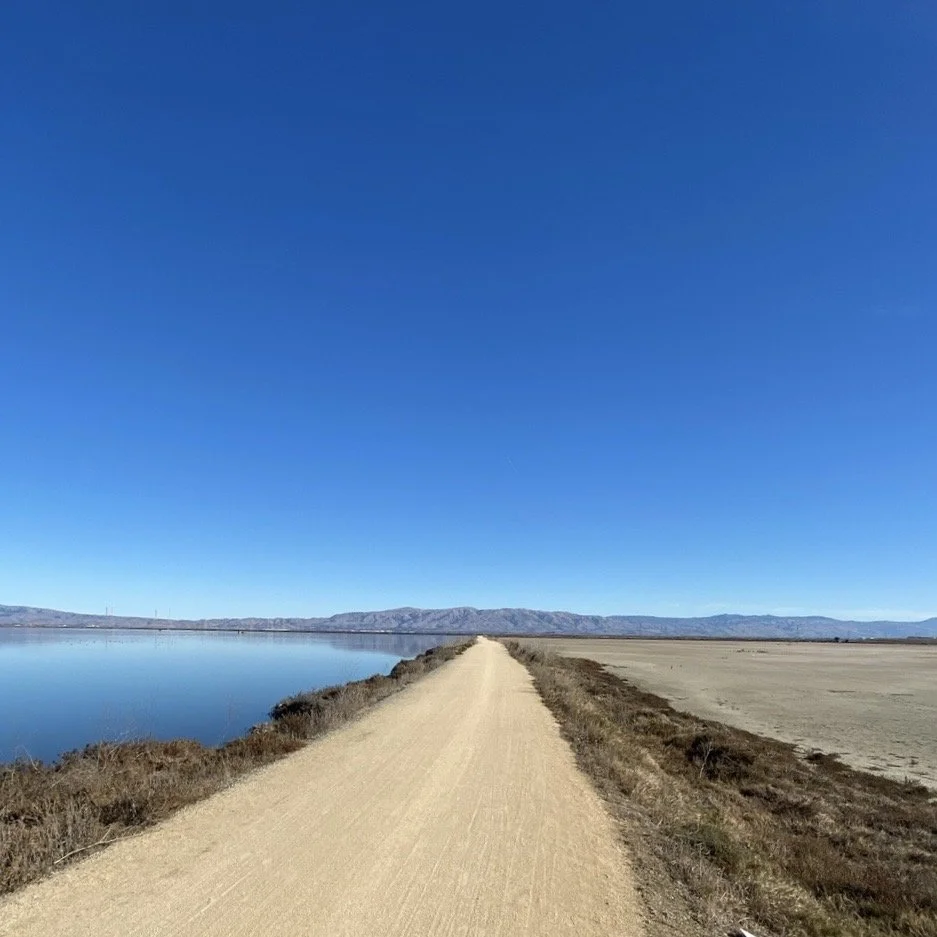
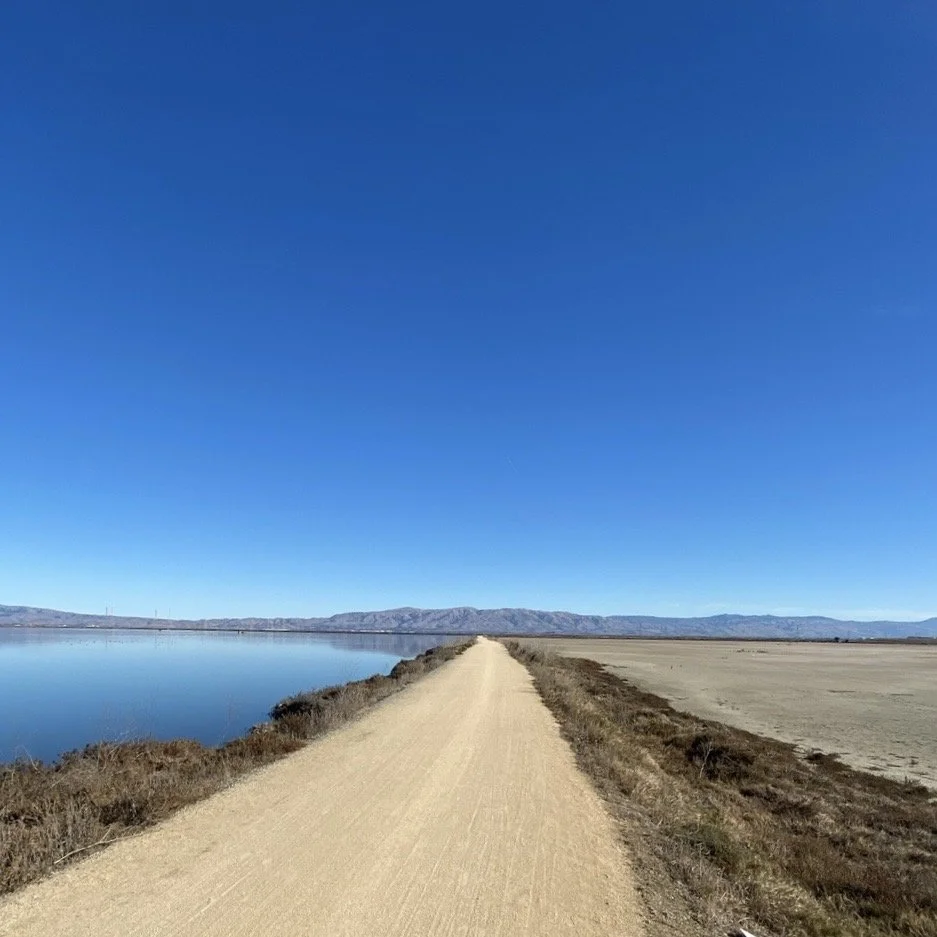
My favorite of the California Crop is “City of San Jose”, and it was born as a direct result of Covid. When the existential despair and cabin fever built up to a boiling point, I would mask up and go for long walks to get some exercise and clear my head. One of my favorite places to do that was the Bay Trail. As the name suggests, the Bay Trail runs along large stretches of the shore of San Francisco Bay. We lived in Sunnyvale, at the southernmost end, in the shallow backwaters and marshlands where the big ships couldn’t go- the domain of pelicans and ruddy ducks and geese. Our stretch of the Bay Trail was a wide gravel and sand path that skirted the edge of Moffett Field. I’d grown up in the cornfields of Miami County, Ohio, so I was no stranger to wide open spaces, but this was a wholly different variety of nothingness: vast, sunbaked, with the foothills of the Diable Mountain Range in the distance. I would set the timer on my phone for an hour and start walking. When the timer ran out, I’d turn around and head back. After six or seven miles of encountering no more than half a dozen people, I’d usually feel better. A bunch of podcasts were listened to, as well as loads of music. I remember listening to Miles Davis’ Filles de Kilimanjaro out there one day, and finally getting it- one of those magical, rare intersections of the right music, the right time, the right place, and the right headspace.
Often, though, I’d just walk and think. I mulled over a lot of heavy thoughts and song lyrics, with just the birds and planes for company. The jets climbing out of San Jose Airport make a sharp right turn over the South Bay after takeoff, to avoid encroaching on the airspace of SFO and the other, smaller airfields that dot the Peninsula (it’s a pretty busy piece of sky). They swing out over the water and circle back over the city, and then adjust their course to their destination. I started contemplating that steady backdrop of pelicans and Southwest 737s and, as my mind is wont to do, chiseled it into a song:
I flew in from Colorado
I’ve been incommunicado for a while
If the last 12 months have taught you anything
It’s that talking’s not my style
But I want to send a quick “top of the morning”
From the bottom of the Bay
Where pelicans and planes fly lazy circles
‘Round the city of San Jose
I spent so many years picking fights
And drinking wisdom from the fountain
Imagine my surprise- the ocean didn't care
And neither did the mountains
So I shut my mouth and shut my eyes
Stepped back and let the wasteland have its say
While pelicans and planes flew lazy circles
‘Round the city of San Jose
You can beat your head against the wall
Waiting for epiphanies and brainstorms
You can stand outside and drown yourself
In the rage and retribution of a rainstorm
As for me, I’m gonna go and see my friends
We’ll sit and wish the day away
Watchin’ pelicans and planes fly lazy circles
‘Round the city of San Jose
We’ll watch those pelicans and planes fly lazy circles
‘Round the city of San Jose
For the music, I used my favorite alternate guitar tuning, DADGAD: bottom string down a step, from E to D, and the top two strings, B and E, both down a step, as well, to A and D. DADGAD sounds sun-dappled to me; it produces a vaguely Joni Mitchell/Led Zeppelin-y sound that I adore, and my fingers love wandering about in that tuning and finding new chord voicings.
When the time came (thanks to the kindness and generosity of my dear friend and biggest booster, Jack Piatt) to head into the studio and record as “Tod Weidner” for the first time, “City of San Jose” was first on the list. The single we recorded that day is streamable wherever you get your music online, and it’s…fine. Really. I like it. The musicians are all great. The producer arranged it as a more upbeat, Americana kind of thing and, in my excitement to be back in the studio, I enthusiastically went along with it. But if I could do it over again, I’d record it the way I play it solo- slower, more meditative. The recorded version feels like a much different song, really.
“CoSJ” is often my choice to open solo sets. It’s “home” to me; I’ve become familiar enough with it to explore its musical nooks and crannies, to stretch it out this way and that. It gets me warmed up, centers me, gets my head right for the set ahead. I think most singer/songwriters have a “home” song like that in their repertoire, a refuge that you can retreat to when things are falling apart in the set. I remember reading that Jimi Hendrix felt that way about “Red House”. “City of San Jose” is my refuge song.
“Basketball Fever” is definitely not.
Here’s a link to a version of “City of San Jose” I recorded at home a while back, much closer to the way I usually approach it nowadays, if you’re interested:
https://soundcloud.com/tod-weidner/tod-weidner-city-of-san-jose
BUNDLES
I really, truly thought I was done worrying about Nuclear War after my teens. Nuclear War was an 80s thing.
One of the most convenient things about being born at the dawn of a decade (aside from the easy math when it comes to determining what age I was when something happened or what age I’ll be when some hypothetical event occurs in the future) is the tendency to tie up the long stretches of time between the rollovers of the first digit on my chronometer into tight, easy bundles of history and culture. I don’t know if it’s that simple with everyone else, but being born in 1970 always felt like a little gift that way. Each decade had a specific palette of events and sense memories, filtered through my age at the time.
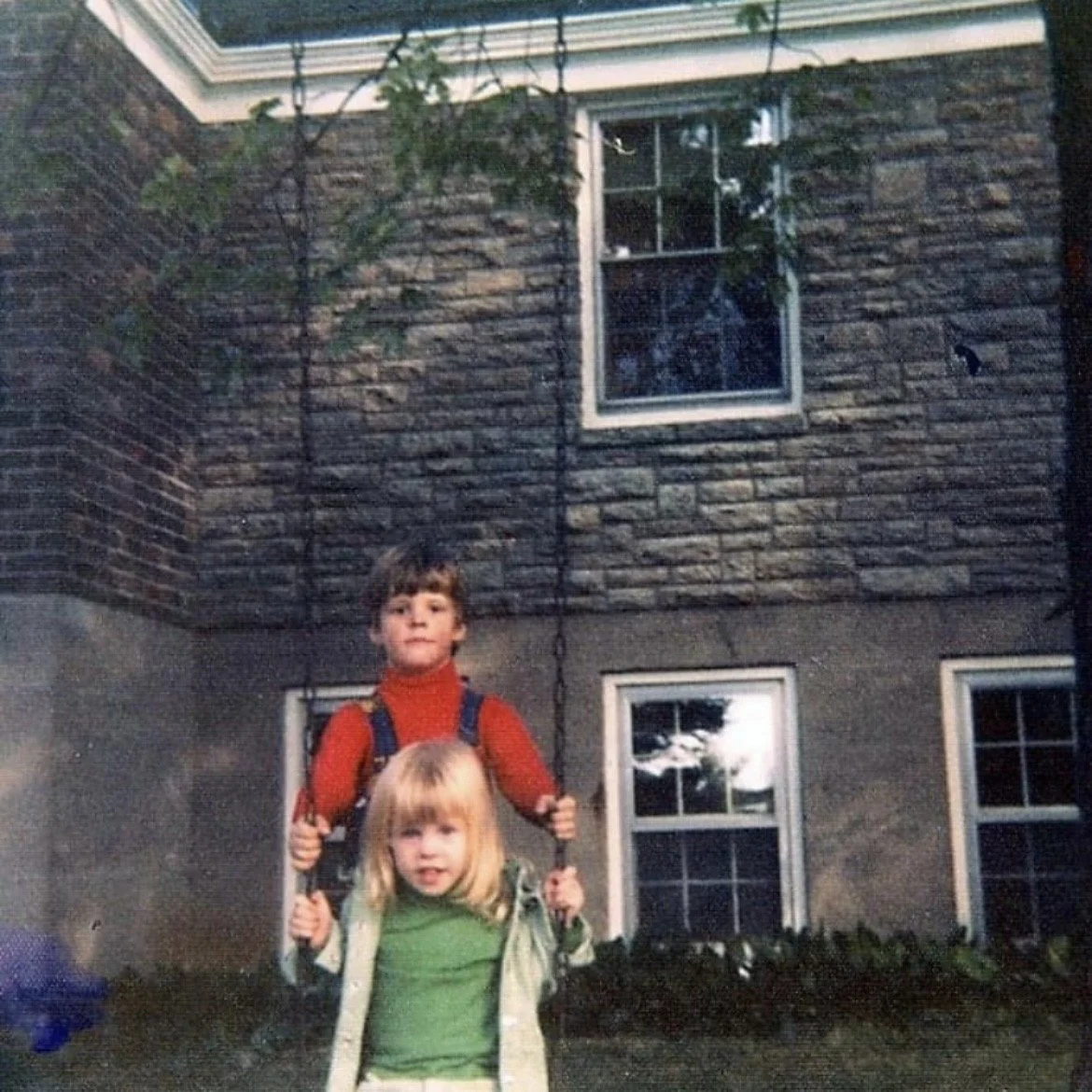
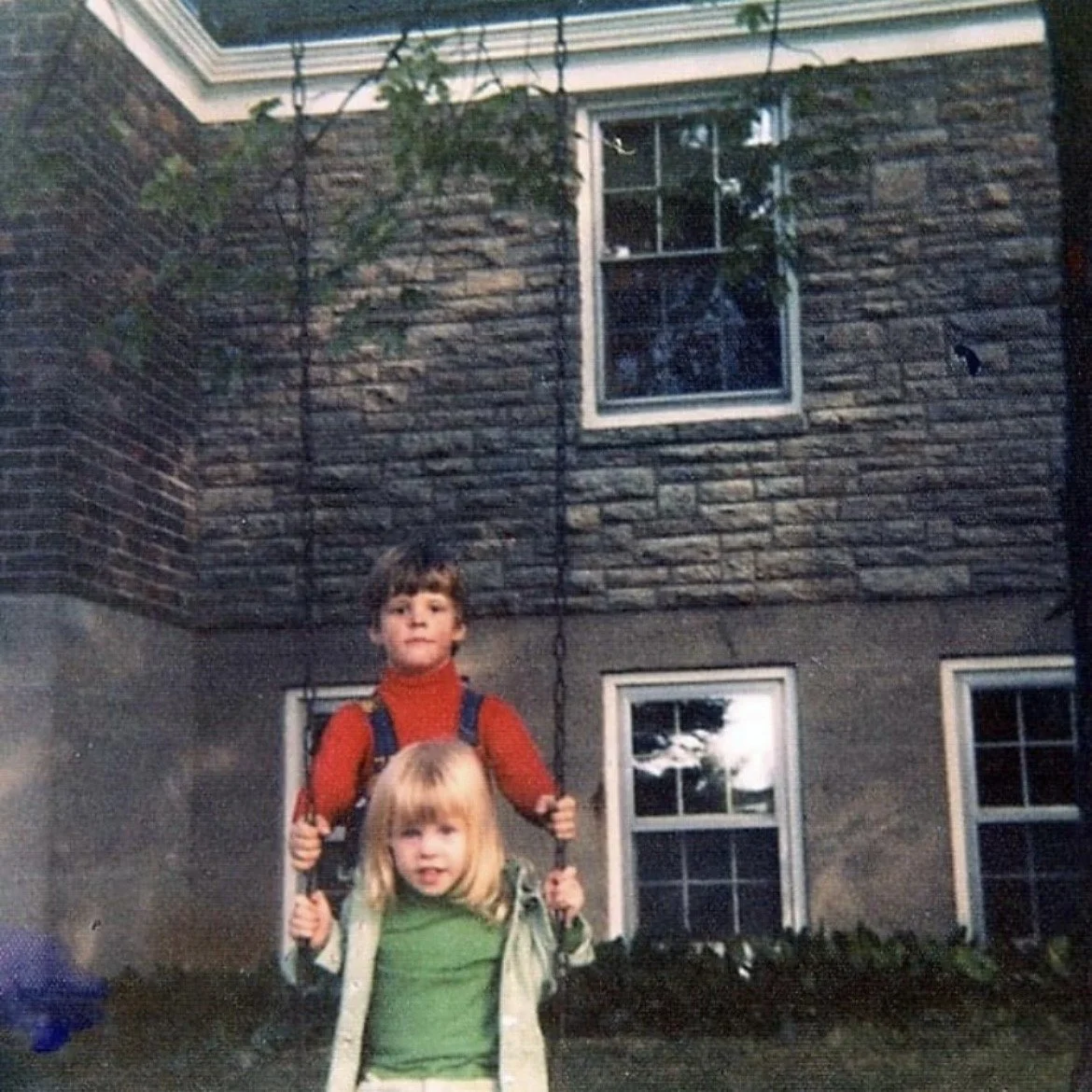
The 70s smelled like cigarettes. Tasted like Pepsi. Lots of earth tones. Sofas were scratchier. Most of the network TV shows seemed to take place out west, either in the Rocky Mountains or what I now recognize as the San Fernando Valley. There were vestiges of leftover 60s counterculture around the margins of my life, mostly confined to Public Television- the vaguely folksy animation on Sesame Street, Morgan Freeman’s “Easy Reader” character on The Electric Company, and the unmistakable whiff of granola and carob when channel 16 was left on long enough to segue into Lilias,Yoga and You or Crockett’s Victory Garden. Muhammad Ali and Davey Concepción and Billie Jean King and Lee Majors. The Fonz, abdicating his throne of Unassailable Cool to Han Solo after one fateful afternoon in the Salem Mall Cinema. Long, hazy, Band-aid-ridden summer days, bathed in the sweat of an active kid too young to be bound to the bathing schedule of puberty. Blizzard-filled winters spent in wet wool, squeaking rubber, and the man-made vrooosh of nylon. I was vaguely aware of the energy crisis, and would later learn just how utterly batshit crazy the decade was, what with all the hijackings and bombings and general revolution, but the 70s for me was mostly just Childhood, as it ideally should be for anyone in their first ten years of life.
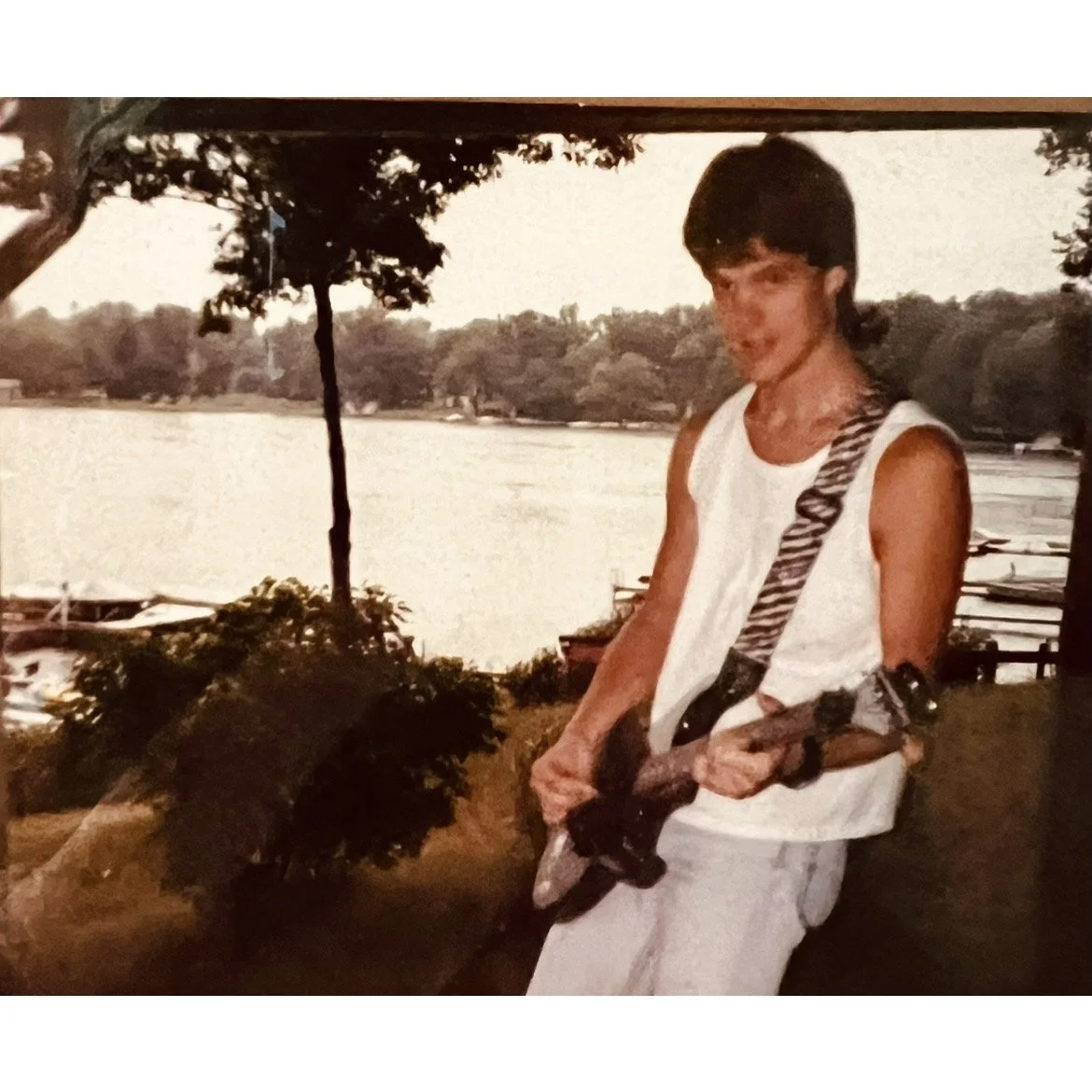
The 80s- and, consequently, my teen years- were louder. They started muted, mere echoes of the 70s, but became steadily more garish, culminating in a fugue state of day-glo and fizz. A lot of the early part of the decade seemed to happen at night, by the light of video game screens and to the soundtrack of the Godfather’s Pizza jukebox, but a bright, beachy, sunbaked patina later took over as the years piled on. It was, in a way, a perfect decade to be a teenager, full of shiny distractions and music coated in a hard candy shell of frosty treble, pretending to be profound but ultimately profoundly shallow, and all competing for my first pittances of disposable income. I gradually began shedding my innocence as more worldly concerns started looming on the horizon. Relatives started to pass away. I became more aware of the news. The Challenger explosion, broadcast in real time on our classroom TVs. The Day After and general Cold War dread. Driver’s Ed. The hormonal Molotov cocktail of adolescence, and the untraceable, unaimed and unaimable angst that comes with it. My first two years of high school, wishing I had the courage to grow my hair out, but instead taking the questionable route of dressing as dorky as humanly possible and choosing “zany” as my central personality trait, all the while absolutely crippled by my crush on the unattainable Lori Waitzman (two years older, head cheerleader, dating the quarterback…it was hopeless). My childhood obsession with airplanes turned into a teenage love affair with the guitar. I soured on organized religion right around the same time, after my first run in with attempted evangelical brainwashing in my Methodist youth group (one bullet dodged, at least). The decade ended with me, besotted with Rock & Roll, struggling through the mullet stage of rock god hair farming, rejecting my previous plans of a career as a fighter pilot and wading deeper and deeper into the waters of Bohemia, winding up in that evergreen refuge of 60s British guitar heroes and other aimless cultural refugees: Art School.
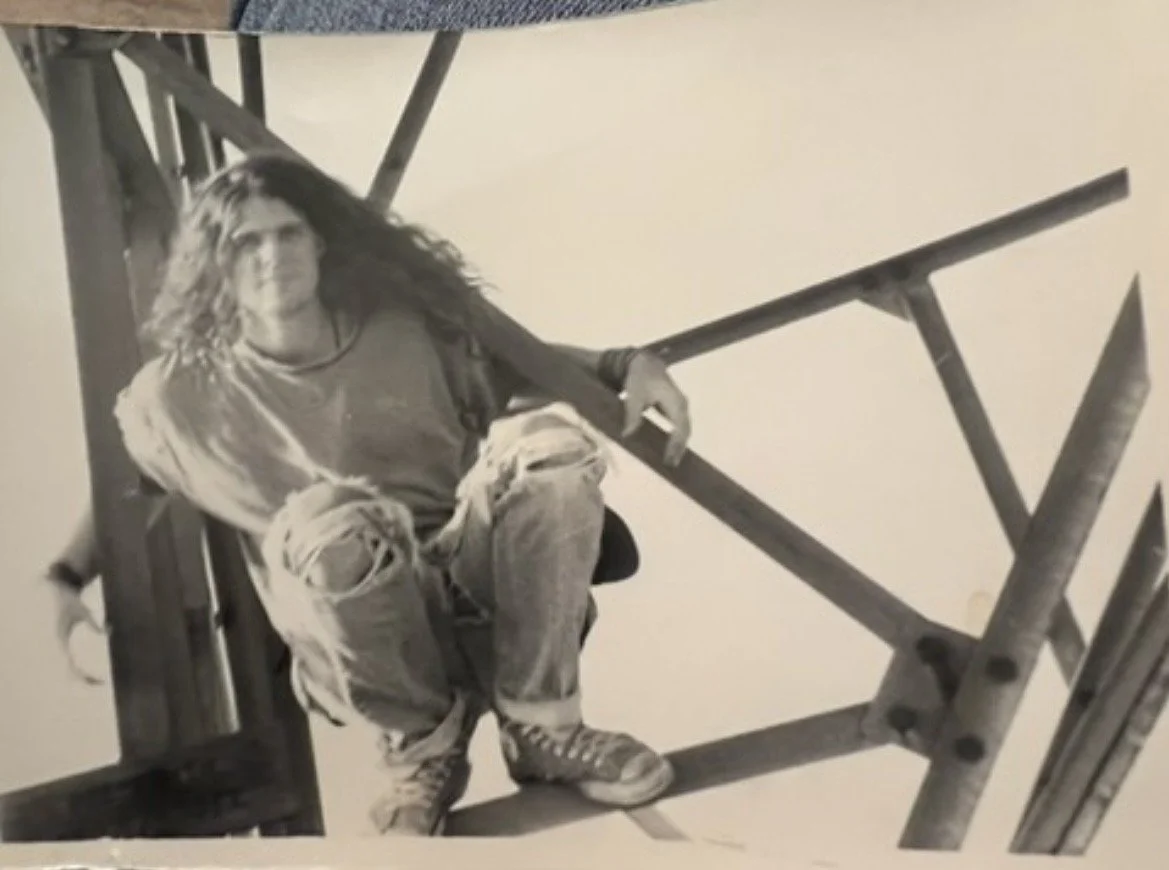
The 90s? In a word, transformative. It was my 20s, after all- my metamorphosis into Adulthood. In the spring of 1990, my two-year scholarship at Columbus College of Art & Design ran out, and my subsequent transfer to Sinclair Community College confirmed my growing suspicion that the life of a commercial artist was not for me. I wanted to be a musician and, since I had no real education in that world beyond dabbling in a few casual groups in high school and college, I created my own curriculum, essentially committing myself to a series of dead-end day-labor jobs that would keep my nights and weekends free and pay for guitar strings. I got an apartment in THE BIG CITY (Dayton, Ohio), lived at or near the poverty line, played in my first serious band, and finally started writing songs. Aside from my first real romantic heartbreak, the 90s were probably the happiest time of my life, and a sizable part of me is still living there, wearing flannel, smelling like coffee and incense, and finding refuge in the sanctuary of music. I figured out who I was in the 90s. I got my first tattoo. I did my first tour. Recorded albums. Developed and embraced my worldview as an increasingly left-leaning secular humanist. Met my wife (take that, Lori Waitzman!). Not much intrinsically has changed since then, other than my hair color, my weight, and the amount of guitars in the house. I mostly missed out on Seinfeld and Friends and a lot of the other pop culture touchstones of the era because I was so busy gigging, or practicing, or watching my friends gigging or practicing. No regrets, really.
My busyness continued as my 20s turned into my 30s in 2000 and the 20-Aughts were a long string of gigs and projects, punctuated by major milestones like getting married in ‘07 and the hope and optimism of Obama’s inauguration, as well cataclysmic events like 9/11, continuing the streak of unending, dirty little wars and conflicts that replaced the Cold War and will probably still be going on long after I’m gone.
It’s such a strange thing, the way that time speeds up as you get older, and the older I get, the harder it is to tie those decades up into tidy bundles. The first half of the 20-Teens were, quite frankly, a blur for me; my musical life had shifted into an even higher gear, and between the relentless weekend-warrior touring I was doing with two different groups coupled in an uneasy, oil-and-water mixture with the construction job I was holding down during the week, I was half insane with exhaustion. As a result, I can’t really pin any given event to any given year. Did it happen in 2011? 2014? 2017? No clue. Reply hazy. Ask again later.
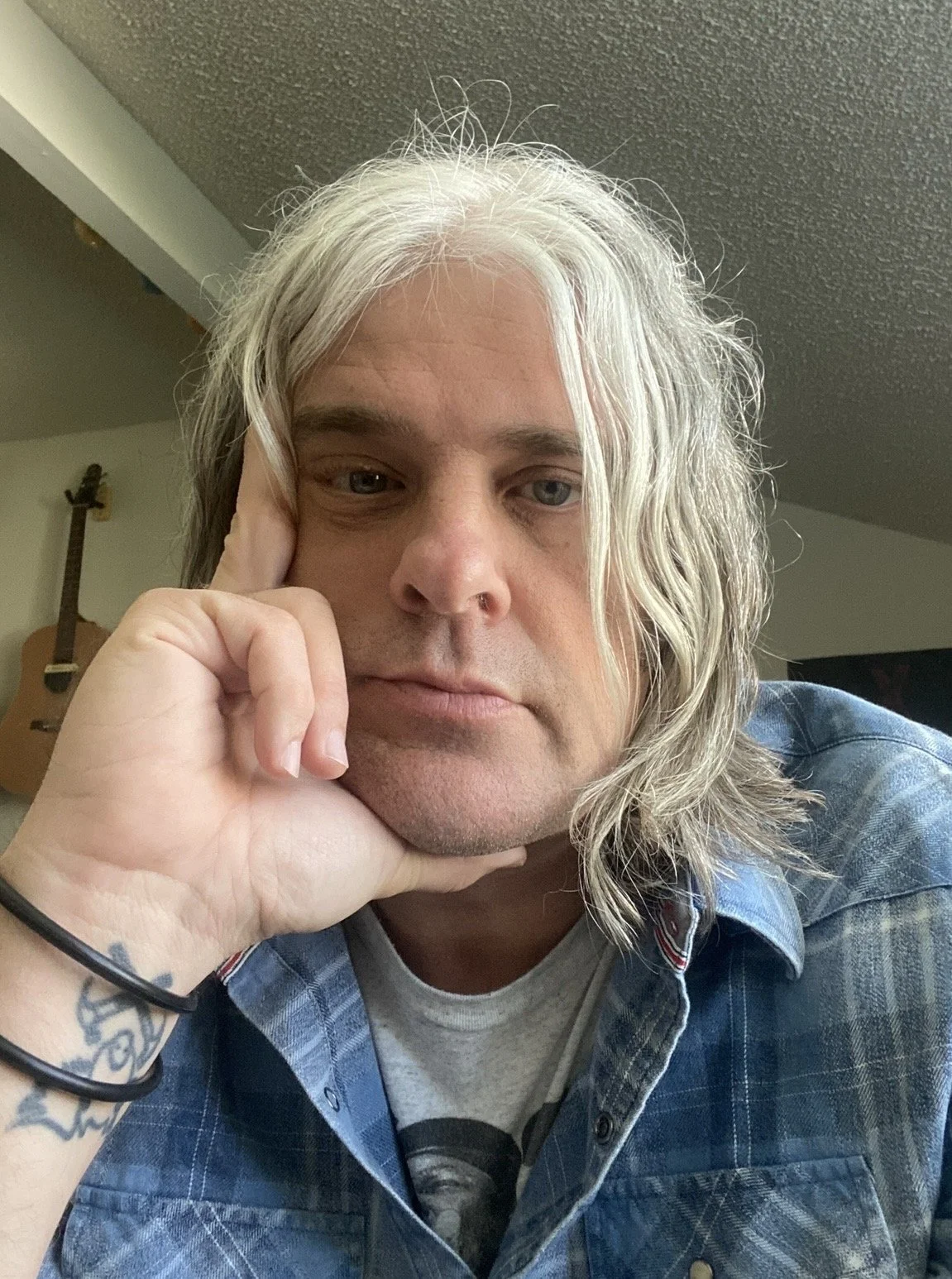
Which brings us up to now: the era of Dorito Mussolini. Covid. Social media. AI. Oligarchy. The compromising of Art. The regimen of crazy pills I don’t remember being prescribed but nonetheless consume every day. The firehose of bullshit, cruelty, and incompetence. The fact that He Who Shall Not Be Named recently threatened the “end of an entire civilization” is so fucking on brand. We know he meant nukes. Just like part of me still lives in the 90s, he’s stuck in the 80s. Think about it. The boxy, ill-fitting suits. The obsession with gold-plated everything. It’s no surprise he would make the jump to nuclear threats, because that was the biggest existential spectre hanging over our heads back then. It’s so maddeningly, infuriatingly predictable. Nuclear War was an 80s thing and now he’s making it a 20s thing.
It’s exhausting. I don’t have to tell you. You’re living through it, too. It takes a concerted effort to put down the phone, turn off the feed, and remember that this is not all there is.
This is not all there is.
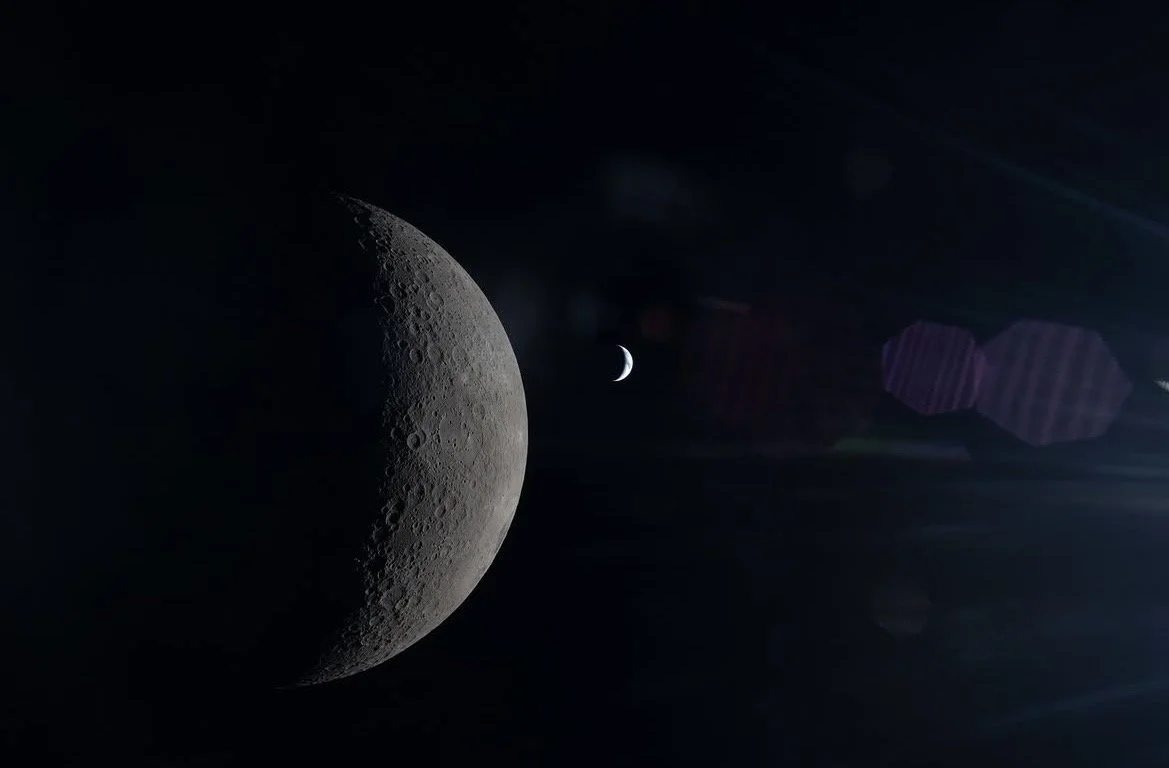
People are waking up and realizing this more and more, I think, and it gives me some hope. The cracks are growing. As I write this, a diverse group of people are on their way back from the Moon, further than any humans have ever ventured from Earth. They took photography classes to capture the sights they were witnessing and share them with us in the most beautiful way possible. They spoke in poetic terms about what they saw, and grappled in wonder with the perspective that can only come with looking back on our tiny, fragile planet from afar. They named a crater after the deceased wife of the command pilot and shed tears while doing so. Love. Compassion. Science.
Humanity.
Closer to home, more and more people are reexamining the value of imperfect human creativity in the face of computer-generated slop. People are rejecting Authoritarianism, standing up for one another, and doing it with weapons Fascism has no counter for: humor and joy.
Humanity.
That’s not to say it doesn’t all get me down. It does. A lot. If you struggle with that, too, my only advice is to stop for a second. Breathe. Think about your life. Think about when you were happiest. Go into your memory and pull that bundle down off the shelf. Carefully untie the twine, or ribbon, or whatever’s keeping it in a nice, organized, easy-to-manage package. Gently open it up and spend some time in it. That person you’re seeing? That’s you. That’s still you. You’re still them. Soak up their energy, their optimism. Tie the bundle back up and put it back. Leave the gun. Take the cannoli. Bring that “happy you” back to the moment at hand and use them as armor. Use them as your weapon. Use them as medicine. If enough of us do that, we might just be OK.
DAMN YOU, ANDY WILLIAMS
I will never get back the time and mental energy I spent as a 6-year-old in 1976 trying to decipher a throwaway novelty pop song from 1958.
This week’s blog is brought to you by the word “mondegreen”. A mondegreen is when the listener mishears a lyric from a song as a funny or nonsensical line as opposed to the actual words. The term was coined by the writer Sylvia Wright, who had heard an old Scottish ballad as a child and interpreted the line“They laid him on the green” as“The Lady Mondegreen”. Some of the more famous mondegreens include “‘Scuse me while I kiss this guy” instead of “‘Scuse me while I kiss the sky”, from Jimi Hendrix’s “Purple Haze”,“There’s a bathroom on the right”instead of “There’s a bad moon on the rise”,from Creedence Clearwater Revival’s “Bad Moon Rising”,“The girl with colitis goes by”in place of“The girl with kaleidoscope eyes”from The Beatles’ “Lucy in the Sky with Diamonds”, et cetera, et cetera. Hell, there are so many misinterpretations of Manfred Mann’s version of Bruce Springsteen’s “Blinded by the Light” that nobody’s really sure what the “revved up like a douche” line actually is. I mean, I guess you could look it up, but where’s the fun in that?
Anyway, I digress. This is the story of yours truly as an extremely unworldly kindergartener, with utterly no frame of reference for Pop Culture (beyond a borderline-maniacal obsession with the TV shows Happy Days and Sha Na Na, that is), mondegreening the living shit out of an Andy Williams record.
A year or so earlier, my younger sister Jill and I had been gifted a battered and scratched stack of unsleeved 45 rpm singles that had belonged to our mom and her sister, our Aunt Pat, in the late 1950s. At every opportunity, we would play them on our little orange GE portable record player, and they slowly pushed our Disney movie soundtrack LPs out of heavy rotation.
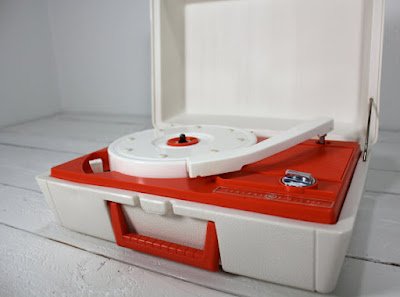
Oh, the flood of sense memories finding this photo online gave me…
It was an absolutely bonkers assortment of songs and artists, that I suspect they got through one of those mail-order record clubs that used to keep sending you stuff in a never-ending flood. I remember some of my favorites were “Chattanooga Choo Choo”by the Glenn Miller Orchestra, (featuring Tex Beneke on vocals!), “Way Down Yonder in New Orleans” by Freddy “Boom Boom” Cannon, “Young Blood” by the Coasters, Tab Hunter’s rather anemic version of Duke Ellington’s “Don’t Get Around Much Anymore”,backed with his even more anemic version of Marty Robbins’ “A White Sport Coat and a Pink Carnation” (which had a bad skip; to this day I hear it in my head: “A white…sport coat… and a piiiinnnk… carrrrrnation… nation… nation… nation…”), and Steve Lawrence’s cover of Buddy Knox’s “Party Doll”. Apparently, Mom and Aunt Pat had a taste for squeakier-cleaner watered-down covers of the Real Stuff, although Lawrence’s “Party Doll” does have a couple absolutely ripping guitar solos. Really. Check it out.
The king of the hill/top of the heap of the collection, the crown jewel, was Elvis Presley’s 1958 hit “All Shook Up” (b/w “That’s When Your Heartaches Begin”), our copy of which I literally wore out, and still adore to this day. A lot of those songs were certifiably unhip, but I can trace my all-encompassing love of music directly back to that weird-ass, beat up stack of 45s, especially that Elvis song. No joke. Along with my well-thumbed copy of Richard Scarry’s What Do People Do All Day?, those records and that little turntable were my prized possessions as a little kid. Those songs are deep in my blood, as lame as some of them undeniably are in retrospect.
Speaking of…
One of the other 45s that sank its teeth in me (capped and snowy, pearly white as they may have been) was another banger from 1958, by Andy Williams. I feel like Andy Williams is slowly fading from the world’s collective memory, which is kind of a shame. He was a crooner in the grand Bing Crosby tradition who had a hit TV variety show for almost a decade. Audrey Hepburn may have sung “Moon River” in the 1961 movie Breakfast at Tiffany’s, but Andy Williams made it his own theme song, recording his version the following year and scoring a massive hit with it. He also made a metric shit ton of Christmas albums and holiday TV specials; chances are, if you hear “It’s the Most Wonderful Time of the Year” when you’re out Christmas shopping, you’re hearing his version.
Good ol’ AW was represented in that old stack of records with his hit single, “Hawaiian Wedding Song”. That track never really grabbed my young ear (too mushy for my taste at the time, probably), but the absolute banger on the B-side sure did: “The House of Bamboo”.
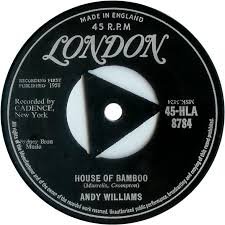
Looking back with 50 years of accumulated life experience, I can now clearly picture the meeting with Williams and his manager and the record label: “Andy, you gotta give the kids something. They’re crazy about this Beatnik scene. We got a song for you- the kids are gonna love it.”
At the time I first heard it, however, I didn’t have the faintest idea what a beatnik was. My worldview was limited. Almost every line in the song flew over my head. Didn’t matter, though. It had bongos. To paraphrase Lloyd Lindsay Young on the Beastie Boys’ “B-Boy Boullabaisse”, it was a trip, it had a funky beat, and I could bug out to it. I sang along to it, too- loud and proud, blissfully unaware of most of what I was singing about, phoneticizing a great deal of the lyrics. The mondegreens, rest assured, were mondegreening.
And now, beloved, I will treat you to what nobody asked for: I will parse the lyrics of “The House of Bamboo”, both as I heard them as a 6-year-old, and with annotations by an older, wiser person who’s had the song stuck in a cobwebby back corner of his brain for nigh on 49 years and is desperate to get it out. Feel free to listen along here:
Number FIfty-Four
The house with the bamboo door
Bamboo roof and bamboo walls
They’ve even got a bamboo floor
(I’m no structural engineer, but this seems like an ill-advised method of construction, especially for a public gathering place.)
You must get to know SoHo Joe
(6-year-old Tod, growing up in neither New York City nor London, but rather in rural Ohio, had no idea where or what SoHo was. So I thought the owner in question was a Korean man named So Ho Cho.)
He runs an espresso
(Again- what’s an espresso? No clue. But I let this one slide with a shrug.)
Called the House of Bamboo
It’s-a made of sticks
Sticks and bricks
(Now hold on. I thought it had a bamboo door, roof, walls, and floor. Now you’re saying it’s made of sticks and bricks? At this point Andy Williams is becoming an unreliable narrator.)
But you can get your kicks
At the House of Bamboo
In this casino
You can drink a ‘chino
(I didn’t know what an espresso was, so what were the odds I’d know what a cappuccino was, much less a slang word for cappuccino (that I’m not sure is actually a thing)? But, again, I let it slide.)
And it’s gotcha swingin’ to the cha cha
(Here’s perhaps the biggest swing-and-a-miss on young Tod’s part: being unfamiliar with the cha cha dance, I assumed a “chacha” was a part of the building. I pictured the chacha being up in the rafters somewhere, like a lofted ceiling. SIDE NOTE: I didn’t realize until I was writing this piece that Andy Williams sings “swingin’ TO the cha cha”. I had, up until now, thought he sang “swingin’ THROUGH the cha cha”, which implies that there was a rope hanging from the ceiling that you could use to swing through the chacha. Seems like a liability lawsuit waiting to happen, So Ho Cho. Hope you’ve lawyered up, or at least make folks sign a waiver before climbing up in the chacha. Someone could get badly hurt, especially if it’s not load-bearing bamboo.)
Dance the bolero in a sombrero
(Bolero??? At this point I was just making sounds with my mouth as I was singing.)
And shake like a snake
(I really liked this part, because a maraca came in during the pause after that line, and it sounded like a rattlesnake. PRODUCTION VALUE!)
You wanna drop in when the cats are hoppin’
(Wait, it’s got cats, too? This place is awesome.)
Let your two feet move-a to the big beat
Pick yourself a kitten and a-listen to a platter
That rocks the jukebox
(So you can come in, have a ‘chino (?) and, while you’re working up the nerve to climb up into the chacha and swing around on the rope, you can pick out one of many kittens that are available to play with. So Ho Cho was a visionary businessman who predicted the rise of modern cat cafés, 60 years ahead of the curve.)
I’m-a tellin’ you
When you’re blue
Well, there’s a lot to do
At the House of Bamboo
(CLEARLY.)
(At this point there’s a groovy little call-and-response with Andy and a guitar. I was already, at the age of 6 [9 years before I actually started playing], zeroing in on guitar parts in songs. My life was pre-ordained, folks; I had no choice.)
(Dut Dut Dut Dunut Nut Nuh)
You’ve got to know
(Da Da Duh)
SoHo Joe
(Dununuh Nut Nut Nuh)
He runs an espresso
Called the House of Bamboo
(Dut Da Duh)
In this casino
You can drink a ‘chino
Let your two feet move-a to the big beat
Pick yourself a kitten and listen to a platter
That rocks
(Really pushing the kittens. Smart marketing.)
I’m a-tellin’ you
When you’re blue
Well there’s a lot to do
At the House of Bamboo.
Number Fifty-Four
The house with the bamboo door
Bamboo roof and bamboo walls
They’ve even got a bamboo floor
In the House of Bamboo
Aaaand, SCENE.
Later on, I realized that Andy wasn’t singing about cats, which paints the House of Bamboo in a different, possibly sordid light. Was So Ho Cho a pimp? Was this a House of Bamboo of ill-repute? A House of Bamboo of the Rising Sun? Or was it just an innocent place to meet girls, like Surf City in the Jan and Dean song? A target-rich environment, as Maverick put it in Top Gun? We may never know for sure.
I was sitting in a drive-through in Camarillo, California yesterday and saw a building across the 101 called the House of Bamboo. I was in a hurry, so I didn’t get to investigate, but not in too big of a hurry to take a photo and text my sister:
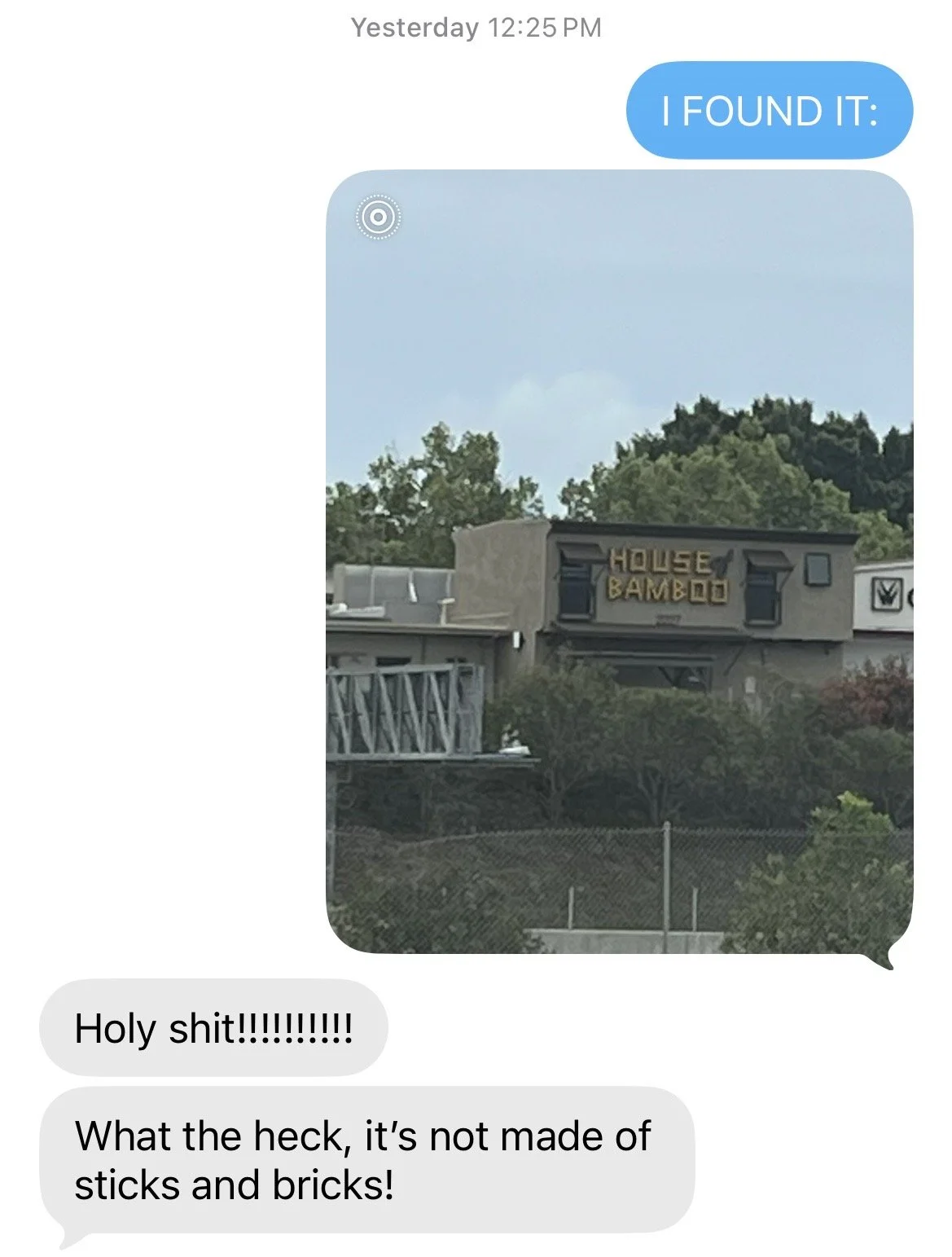
Our ensuing conversation put this song back in my head. I had to exorcise it by writing this blog. I’m sorry/you’re welcome.
Weirdly, while I was researching “The House of Bamboo” I learned that last year, 67 years after its release, “THoB” actually charted in the UK, thanks to its being featured in the TV show This City Is Ours, so maybe I counted Andy Williams out prematurely. I can only hope that this weird little earworm of a song is alive again, feeding on the young clueless brains of a new generation, and that there’s at least one little British kid who’s hearing it, bopping around the house, and wondering what a chacha is. Damn you, Andy Williams. And thank you.
YA GOTTA KEEP ‘EM CAFFEINATED
As the world –metaphorically speaking– continues to take foggy mountain roads at faster and faster speeds and spend more time on two wheels than four, I find myself (here in my fetal position in the back seat) looking for new ways to stay grounded, centered, and present; to try and curb my tendency to stew and spiral. I wish it was easier. I come from a long line of worriers. Anxiety and rumination often feel like my factory default settings and, after a recent longer, bleaker period than usual of letting existential dread and despair wash over me, I’ve decided that a reset is long overdue.
As a result, I’ve recently doubled down on developing some new habits. Good ones, that is; I’ve already got enough of the other kind, thank you very much. For some examples: I’m exercising every day. I’m writing this blog you’re reading right now; I promised myself I’d write and post an entry a week and, six weeks in, that’s exactly what I’ve done. And, most recently, I’ve started a series in my Instagram stories: “T.I.D.”, or “Today I’m Digging”. I pick a little thing that I’m doing, or something that catches my ear or my eye, and I celebrate it. It’s similar to one of those “Inhale for 4 seconds, hold for 7, exhale for 8” breathing exercises. It forces me to slow down, to notice the beauty that’s still around us in abundance, despite what the news tries to tell us. I’m trying to do it on a daily basis. I’m not quite there yet, but it’s on its way to becoming a habit, and by telling myself to keep an eye out for today’s T.I.D., I feel like I’m slowly rewiring my brain, recalibrating the way I approach my life- my own little version of a gratitude journal. If nothing else, it helps make my corner of Instagram a happier place, and that’s good enough for me.
All these little self-imposed steps and tasks are doing a pretty good job of giving my day a sense of positive structure. I realize it’s at odds with my chaotic-by-nature chosen vocation as a “creative type”, but I’m a sucker for structure. Always have been. I thrive on procedure and routine (if there’s any truth to the whole “past lives” thing, I’m pretty sure that I was a soldier in many of my previous trips around the block). At the same time, I’m trying to say “yes” to things as much as possible, to invite a little serendipity in, while hoping it plays nice with my love of order and duty and service. It’s a razor’s edge. You remember Aesop’s fable about the grasshopper and the ants? There are plenty of both of those critters in my bloodline, and the struggle of that dichotomy, as they say, is real.
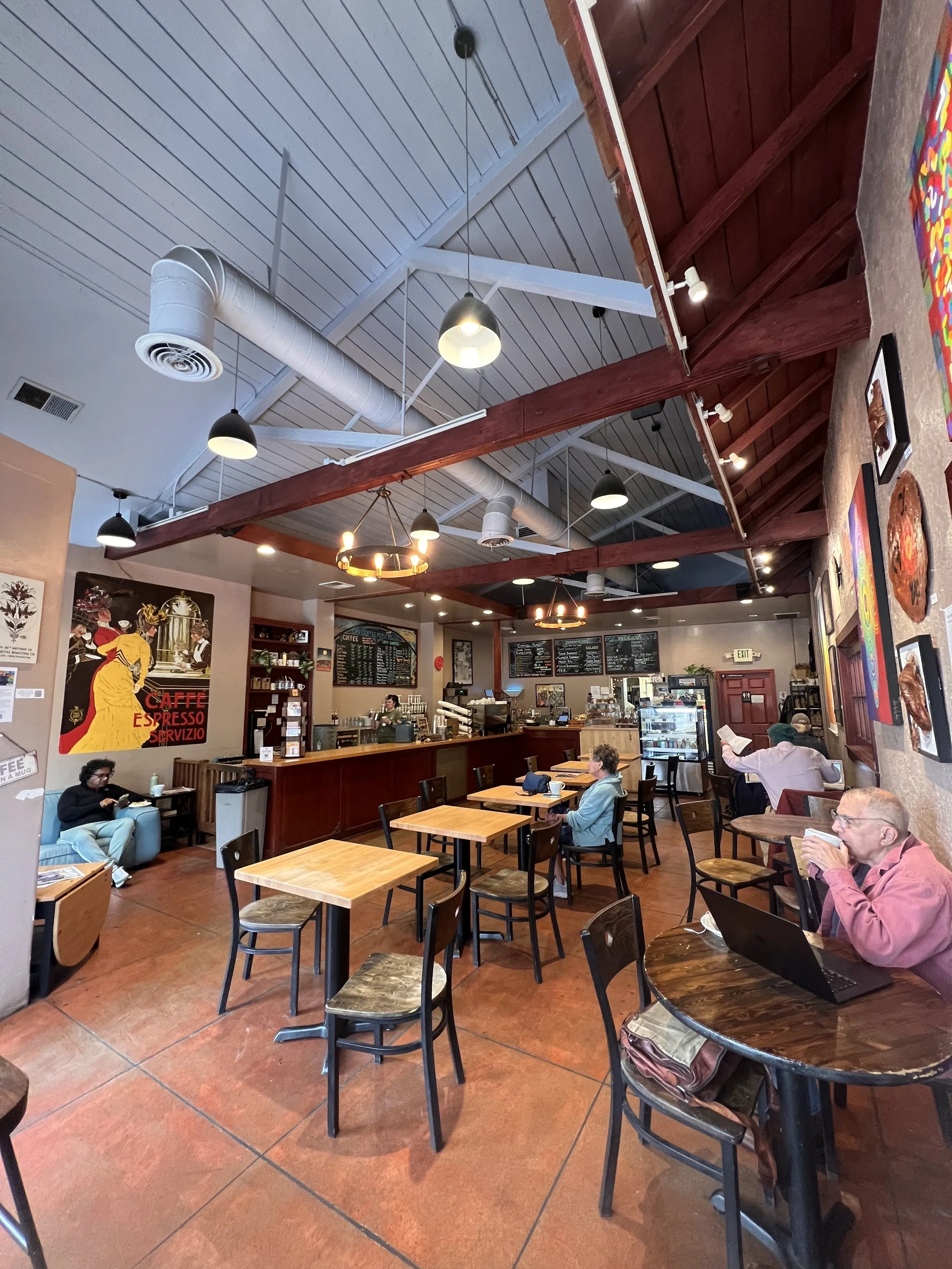
Ojai Coffee Roasters, my portal to 1995.
There’s a little place downtown- Ojai Coffee Roasters. When my wife and I moved to Ojai three and a half years ago, I started going there most mornings to write (speaking of habits, that’s one I’m trying hard to pick up again.). Ojai Coffee was like a portal to 1995, when I would hang out at Front Street Coffee House in Dayton, Ohio every night, writing the first batch of Shrug songs and jacking myself up beyond all reason on caffeine. Ojai Coffee brought me full circle back to that world. I started churning out lyrics and became friends with the owner, Stacey, as well as the rest of the staff.
This is not a tangent. Stick with me.
Last September I got back to Ojai after spending a month and a half in Ohio. My dad’s health was failing, and I had gone back home to spend time with him and help my mom and sister with all the things that come with the end of a loved one’s life (duty and procedure, amiright?). On my first visit back to the shop, Stacey sat down at my table and we talked about dying parents, grief, family obligation, and such. She was, as always, very kind. The conversation changed to what I’d missed since leaving town and she mentioned that the employee whose job it was to roast the coffee in house was moving out of the area. It had been on Stacey’s radar, but the departure had been bumped up suddenly, and Stacey was trying to figure things out.
Under her breath she quipped, “I don’t suppose you’d be interested in learning how to roast coffee…?”
We chuckled. Then I stopped chuckling and started thinking. I thought about how many of my favorite jobs, music projects, side quests, and adventures I had fallen back-asswards into, out of the blue. I thought about the funk I was in with my dad’s situation and the general shambolic state of the world, and how maybe getting out of my own head a little and trying something new would do me some good and help distract me. I thought about how I needed to start saying “yes” again. After hearing that it required only a few hours of my time a week, I signed on as a Roaster To Be.
I’m 55 years old, people. The overwhelming majority of my day to day life consists of activities I’ve done hundreds, if not thousands, of times. The chance to start as an absolute beginner at something –from square one– at my age and learn an entirely new skill is rare. It’s intimidating and scary. But it’s also pretty exhilarating. I had never seen a coffee roasting machine before. I had never seen a raw coffee bean before. So you can imagine the barrage of new information lobbed at me at my first training session. I took copious notes, made little drawings, determined not to screw up. Stacey’s daughter, Olivia, was also learning the ropes with me. We arranged that I would roast on Mondays and Olivia would take Thursdays and, after a couple sessions, keeping an eye on each other, making some mistakes, and recovering from them, we flew solo.
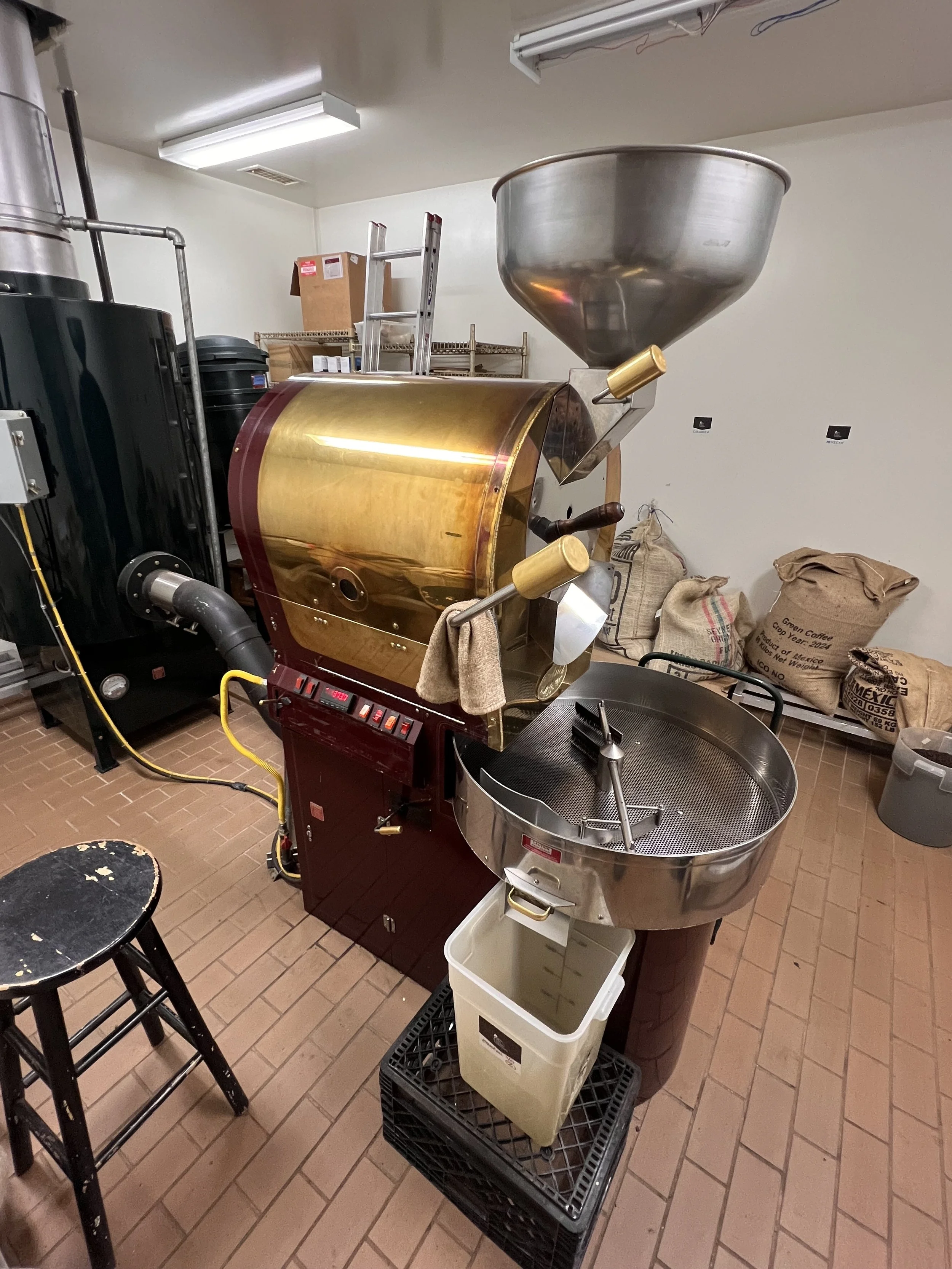
“Isn’t she looooovely…”
The airplane analogy is not a perfect one, but it does fit. My procedure fetish has a warm, cozy home in coffee roasting. The roaster itself is a big, beautiful, vaguely Jules Verne-ish contraption, all brass levers and gauges, chutes and hoppers, and getting a consistent roast requires attention and repetition. Each roast ideally takes between 19 and 22 minutes. The digital temperature display needs to show a rate of increase of roughly 5 seconds per degree. Too fast, and the beans don’t roast in the middle. Too slow, and you’re just baking them instead of roasting. Light roast Ethiopian and Decaf Peruvian come out at 425. Medium roasts, anywhere from 435 to 445. Darker roasts stay in until 460. There are checklists and steps that need to be done and entered in a log along the way, all to the steady heartbeat of 5 seconds per degree:
Gas lever up full airflow lever up full to cooling bin setting power switch on motor switch on burner switch on watch through viewport and wait for burners to light once lit evenly adjust gas lever for 5 seconds per degree rise rate first roast goes in at 400 stopwatch on log start time keep temperature rise rate at 5 seconds per degree at 300 airflow lever all the way down to roasting bin setting for a minute or so until most of the chaff is gone from the bin viewing port airflow back up to cooling bin keeping checking the temperature rise rate move airflow lever to half between 366 and 375 when the beans start turning cinnamon brown in viewport watch that temperature rise rate as temperature nears 388 open bean inspector shaft and listen for first crack when beans start cracking like popcorn move airflow lever full down and log time and temperature at 400 log afterburner reading turn on cooling bin motor and load next roast into hopper listen for second crack around 438 log time and temperature airflow full up gas lever off note temperature empty beans from roaster into cooling bin close rooster bin wipe down chute and inside of roaster bin hatch open hopper empty new roast into roaster reset stopwatch log time and final temperature watch for temperature display to bottom out relight burners adjust gas to halfway when temperature starts rising repeat steps with new roast empty beans from cooling bin at 300 wipe down cooling bin chute when finished roasting clean chaff out of air supply cavities clean fan blades every other roast chaff collection tube every 4 or 5 roasts oil motor every month rear bearings every 40 hours front bearings every 6 months restock beans up front make any notes for Olivia’s Thursday roast repeat next Monday wham bam thank you maam
As this little dance becomes a routine and I’ve internalized the steps, the initial anxiety has given way to a kind of serenity that comes with making a practice out of something. Watching the beans being sifted in the cooling bin is a hypnotic, Zen-like experience. My previous life as a radio host (another shining example of saying “yes” to serendipity) has gifted me a very accurate internal clock and I find myself meditating on “one…two…three…four…five…” whether I’m watching the temperature display or not. Honestly, the most stressful part of the whole process is determining what batches of beans need restocked when I start my shift.
OH- and the smell. The smell. Delightful. I come home every Monday smelling like coffee, and my wife who, in an earlier life, chased the coffee dragon until she had to quit and switch over to tea, keeps walking past and sniffing me for a little micro dose hit of her past.
Stacey’s a kind soul and a good boss, and Ojai Coffee is a happy ship. I’m proud to be a part of it. What started as an out-of-left-field “yes” has become a centerpiece of my week. Structure and serendipity, living in symbiosis. And any shakes I get from too much free coffee are alleviated by the knowledge I’m being of service to something and learning a craft. I’m no expert, not by a long shot, but I’m working on that. In the meantime, raise a cup of joe and join me in a toast:
To healthy new tricks for old dogs. Woof.
Ojai Coffee Roasters ships its coffee anywhere. If you’d like to sample my handiwork, here’s their website.
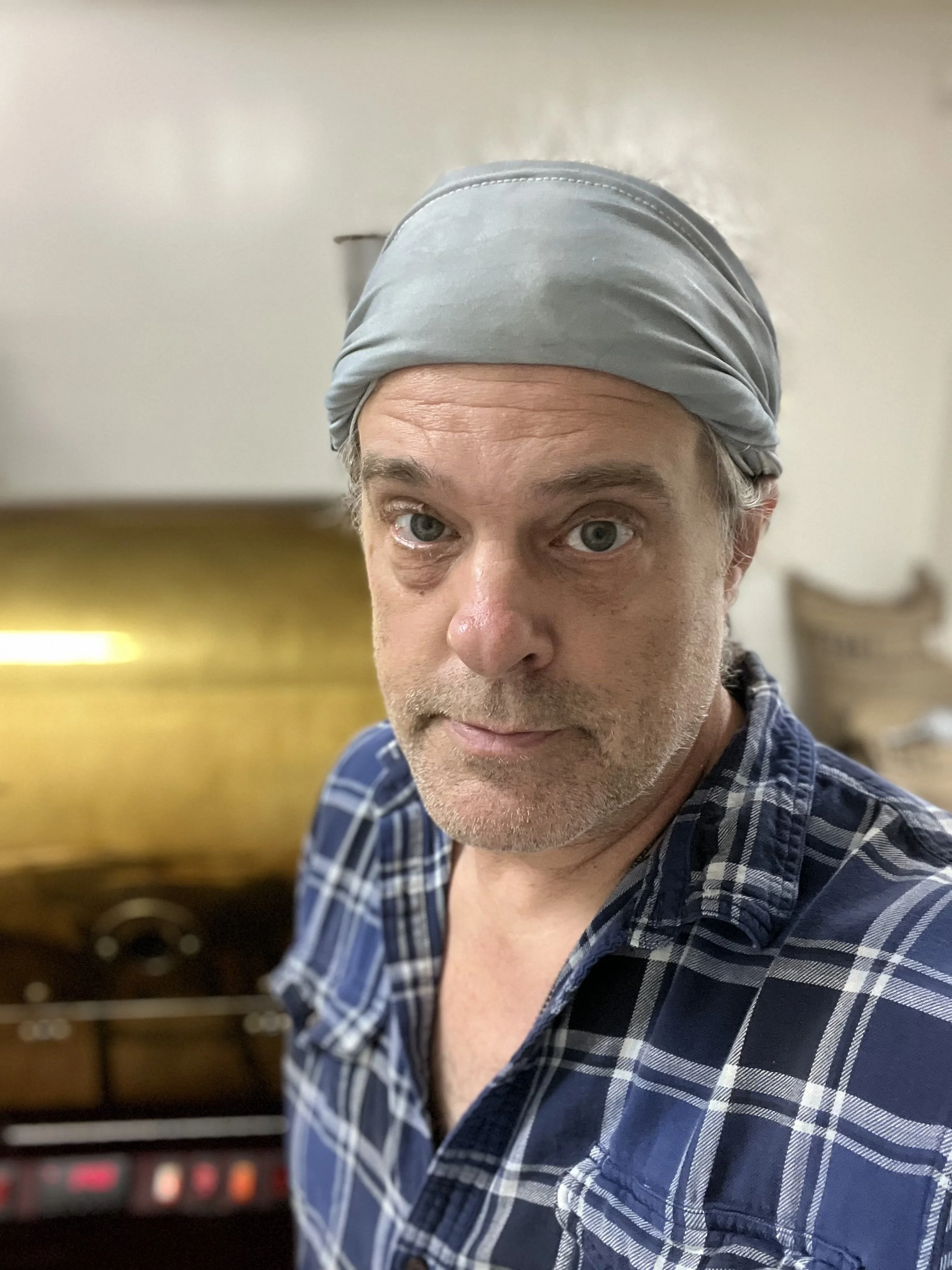
WHEN THE GOOD GUYS WIN
I’ve got some good news for you.
Good news is in exceedingly short supply these days, isn’t it? It’s practically unobtainium, in fact. I’m 100% certain you didn’t need me to tell you that, because you’re an informed, sentient human, raised to try to do the right thing and care about other people. I’m one, too. And it’s been exhausting and disheartening, these years and years of seeing people like you and me suffer under the actions of a handful of old men (and they are almost always old men, aren’t they?) who have had the empathy-shaped holes in their souls filled in by money and power, like lumps of cold solder. It’s dismaying in ways that will wear you down and numb you if you’re not mindful, to the point that, when a truly mind bogglingly egregious thing occurs, it shakes you out of a stupor you were barely aware you were in and throws a harsh spotlight on all the stuff you had been dissociating yourself from and it all comes flooding in and it’s a whole thing and it breaks your heart all over again.
Just me?
Nah, I doubt it.
Anyway, I got off topic. That’s not what I opened up the laptop to write about. Like I said- I’ve got some good news, and it hit me like a shot of badly-needed B12.
I have a dear friend named Jack Piatt. Those who know me have seen and heard that name pop up a lot over the years. Jack and I grew up about 25-or-so minutes apart, in the Ohio cornfields of Preble and Miami Counties, respectively. We didn’t actually meet until our 20s, though, when his Uncle George (a mensch in his own right) brought him to Canal Street Tavern one evening in the late 90s to see my band Shrug play. I had no inkling at the time how much the course of my life changed that night.
Since that night, Jack has been a constant champion of my music. He’s believed in me even in the times when I didn’t, he’s spoken my name in more rooms than I’ll ever know, and damn near every cool opportunity that has come my way since I moved to California has been, directly or indirectly, a result of Jack’s doing. He’s never failed to deliver the goods on something he’s told me about and, as a result, I’d follow Jack into Hell.
He’s a gifted poet, writer, and filmmaker, but above all, I’d call Jack a professional Lifter. He lifts people up. He’s a kind, thoughtful, honest person, who truly cares about folks. He got me back in the habit of saying “you’re welcome” instead of “sure thing” or “no problem” when someone thanks me for something; an acknowledgement that, instead of brushing off the transaction, says, “Yes, I did you a service, and I was happy to, and I’d do it again.” It’s a subtle distinction, but a real one. A Real One, just like Jack
Last year, Jack helped produce a short film called The Singers. It’s based on a 19th-Century story by the Russian writer Ivan Turgenev, about a collection of down-on-their-luck societal misfits who have an impromptu singing contest in a bar. The Singers is a Caravaggio painting brought to life, beautifully shot by director Sam Davis, and the decision to cast the film entirely with actual singers, buskers, and performers with no professional acting experience was a creative gamble that paid off in spades. You really believe these folks, because…well…they’re real. I’ve seen it at least a half dozen times, in various forms, from rough cuts to the finished product, and I have laughed out loud and cried every single time. I told Jack after watching the first rough version how deeply moving it was, how it was something special, and the best thing he’s ever been involved in.
Turns out I was not alone in this opinion because, after bagging 35 awards in 50 film festivals, The Singers won an Academy Award for Best Live Action Short Film (in an ultra-rare 2-way tie with Two Strangers Exchanging Saliva) this past Sunday.
My man Jack now has an Oscar, and I can’t fully express how over-the-moon proud I am of him and the whole cast and crew. There’s a lot of good left in the world, and we need to celebrate it, now more than ever.
The Singers is now streaming on Netflix. I urge you to do yourself and your sense of humanity a huge solid and check it out.
You’re welcome.
CONNECTING (or the Gospels of Monk and Beefheart)
All things being equal, I’d rather be known as a good musician than as a good guitarist.
I’m not saying I’m either of those things, mind you. I’m speaking in strictly aspirational terms. The journey’s never over, and I’m light years away from where I want to be in both realms, but still…I’d rather be known as a good musician than as a good guitarist.
There’s a subtle distinction between those two things- one that laypersons (by which I mean those without the affliction of being compelled to create music) may not be aware of on the surface, but the distinction is there, and it’s an important one. That difference is what makes some music audio wallpaper and other music a miraculous, life-enriching experience.
I’d rather be known as a good musician than as a good guitarist.
For my purposes I’m using the term “guitarist”, because guitar’s my chosen instrument, the one that sank its teeth into me 40 years, three months and (*checks date*) six days ago, and never let go. But you can plug any other instrument into that sentence and it’ll work just fine, because the principle is universal.
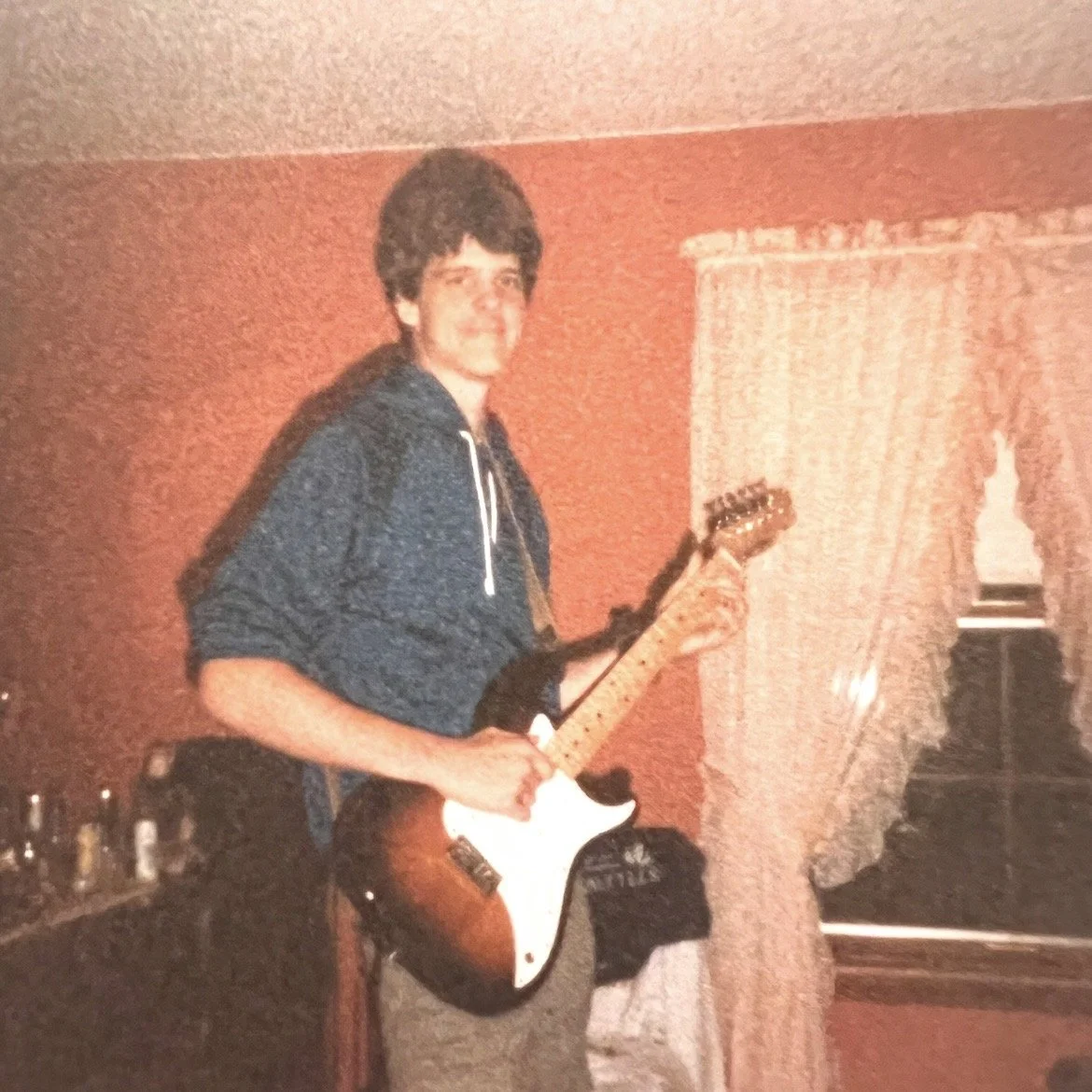
Control yourselves, ladies.
To save you from having to do the math, I got my first guitar on January 4th, 1986. I was a fifteen-year-old in the rural midwestern US. Aside from a bizarre and precocious obsession with 30s and 40s big band Swing a few years earlier, the main conduits to music in my isolated, MTV-less life were the two area radio stations powerful enough to reach the barren wastelands I called home. One was Z93, which peddled Top 40 Pop. The other was WTUE. ‘TUE focused on the “Classic Rock” of the 60s and 70s, while liberally sprinkling in the contemporary hard rock and heavy metal that was enjoying its heyday in that neck of the woods. Being a teenage boy with a thirst for bombast and a surplus of testosterone (and no other responsible way of using either), it’s no surprise that I steered clear of the lighter pop of Z93 and gravitated to the other option. I was a ‘TUE kid.
It was a halcyon time for excess, the 80s were, and the world of hard rock distilled the times to a tee. Nearly every band was a whirlwind of color and spandex, and the Aqua Net budgets alone dwarfed the entire recording and touring budgets of your average modern-day group. But even more crucially, every band needed a hot shot guitar slinger. Guitar solos were epic displays of virtuosity and acrobatics, meant to drop jaws (and other things), and may merciful God help you on the Billboard charts if your song didn’t have one. It was the Age of Shred. Edward Van Halen, Yngwie Malmsteen, and Randy Rhoads were the Father, the Son, and the Holy Ghost.
I confess to having a soft spot for a lot of that music to this day; after all, the stuff you listen to in your teen years will always stick with you and, as a young pup trying to crack the code of what a guitar could do, all that flash was a good motivator to practice. But on an artistic level, most of that stuff was empty calories, a big bowl of Fruity Pebbles for breakfast that leaves you exhausted and drained in fourth-period Algebra once the sugar wears off. The lyrics were, by and large, afterthoughts- vapid and vacant, not particularly geared for introspection. I realize now that this was clearly a byproduct of the copious amounts of high-quality Peruvian marching powder consumed by the music business at the time. Who cares about the Human Condition when you’re gakked to the gills? I’m not saying there’s not a place for celebratory good-time tuneage, but making it a staple of your diet is akin to living on Mountain Dew and Funyuns. It’s just not sustainable. You gotta eat a salad every now and then.
So, what happened to me? Metaphorically speaking, I learned to like salad. I got older. My tastes changed. I played in a lot of bands. And I started noticing that delicious alchemy that occurs when players change the focus from trying to impress to trying to connect, with one another as well as the listener.
Most of my favorite bands feel like one big collective instrument in and of themselves, each member providing a simple, vital piece of the puzzle that meshes with what the others are playing and makes something undeniably, viscerally communal. The Rolling Stones are the first group that comes to mind. I know you’ve heard it thousands of times already, but listen to “Jumpin’ Jack Flash”. Or “Gimme Shelter”. Those songs are groove machines, churning away, no one’s playing anything particularly difficult, but take any single element out, and the whole thing would fall apart, or at least be a shadow of itself. Africa 70, fronted by the legendary Nigerian bandleader Fela Kuti is another example. Hell, James Brown made The Groove his entire life’s work.
The mighty Fela Anikúlápó Kuti. Approximately 3000% cooler than that kid in the first photo.
In each of those examples, the band members are listening to one another- having a conversation. And that’s a skill that doesn’t come as easily to musicians– especially technically-gifted ones– as one might assume.There’s a temptation to throw your entire education into a performance, but that becomes about as fun to the other musicians as talking to somebody who, instead of processing what you’re telling them, is planning what they’re going to say next when you finally shut up. The longer I do this, the more I become aware that the most essential pieces of gear I have in my rig are the two holes on either side of my head.
When everybody’s listening and the performance becomes a conversation instead of a lecture, the veil is pierced, and the Door opens. Sound becomes music. The audience can always tell when it’s truly cooking. They’ll react accordingly, and the resulting self-sustaining feedback loop is a wondrous, magical thing.
To that point…
I’d rather be known as a good musician than as a good guitarist.
This all makes me think of two of the all-time bonafide wiggy-brilliant eccentrics in modern music: Thelonious Monk, the beloved and deeply quirky jazz composer, pianist and bandleader (to whom the name of my blog gives an affectionate nod and wink), and Don Van Vliet, a childhood friend of Frank Zappa’s who went on to dub himself Captain Beefheart and lead his Magic Band into some truly mindbending places. Monk’s Rules were jotted down by his sax player, Steve Lacy, at a session and, while some are absolute head scratchers (guess you had to be there), some are actually quite profound. Captain Beefheart’s Ten Commandments are technically aimed at guitarists joining his band, but most of the points can be adapted to other instruments. I’m attaching both lists here for your entertainment and education.
By the way, they're not just for musicians, either. I submit to you the notion that if we all listened more than we spoke, kept our need to show off in check, and embraced the power of substance and connection over artifice, the world might be in a better place.
LET’S LIFT THE BAND STAND.
THELONIOUS MONK’S 25 TIPS FOR MUSICIANS:
Just because you’re not a drummer, doesn’t mean that you don’t have to keep time.
Pat your foot and sing the melody in your head when you play.
Stop playing all that bullshit, those weird notes, play the melody!
Make the drummer sound good.
Discrimination is important.
You’ve got to dig it to dig it, you dig?
All reet!
Always know
It must be always night, otherwise they wouldn’t need the lights.
Let’s lift the band stand!!
I want to avoid the hecklers.
Don’t play the piano part, I am playing that. Don’t listen to me, I am supposed to be accompanying you!
The inside of the tune (the bridge) is the part that makes the outside sound good.
Don’t play everything (or everytime); let some things go by. Some music just imagined.
What you don’t play can be more important than what you do play.
A note can be small as a pin or as big as the world, it depends on your imagination.
Stay in shape! Sometimes a musician waits for a gig & when it comes, he’s out of shape & can’t make it.
When you are swinging, swing some more!
(What should we wear tonight?) Sharp as possible!
Always leave them wanting more.
Don’t sound anybody for a gig, just be on the scene.
Those pieces were written so as to have something to play & to get cats interested enough to come to rehearsal!
You’ve got it! If you don’t want to play, tell a joke or dance, but in any case, you got it! (to a drummer who didn’t want to solo).
Whatever you think can’t be done, somebody will come along & do it. A genius is the one most like himself.
They tried to get me to hate white people, but someone would always come along & spoil it.
CAPTAIN BEEFHEART’S TEN COMMANDMENTS OF GUITAR
1. Listen to the birds
“That’s where all the music comes from. Birds know everything about how it should sound and where that sound should come from. And watch hummingbirds. They fly really fast, but a lot of times they aren’t going anywhere.”
2. Your guitar is not really a guitar
“Your guitar is a divining rod. Use it to find spirits in the other world and bring them over. A guitar is also a fishing rod. If you’re good, you’ll land a big one.”
3. Practice in front of a bush
“Wait until the moon is out, then go outside, eat a multi-grained bread and play your guitar to a bush. If the bush doesn’t shake, eat another piece of bread.”
4. Walk with the devil
“Old Delta blues players referred to guitar amplifiers as the ‘devil box’. And they were right. You have to be an equal opportunity employer in terms of who you’re bringing over from the other side. Electricity attracts devils and demons.
“Other instruments attract other spirits. An acoustic guitar attracts Casper. A mandolin attracts Wendy. But an electric guitar attracts Beelzebub.”
5. If you’re guilty of thinking, you’re out
“If your brain is part of the process, you’re missing it. You should play like a drowning man, struggling to reach shore. If you can trap that feeling, then you have something that is fur bearing.”
6. Never point your guitar at anyone
“Your instrument has more clout than lightning. Just hit a big chord then run outside to hear it. But make sure you are not standing in an open field.”
7. Always carry a church key
“That’s your key-man clause. Like One String Sam. He’s one. He was a Detroit street musician who played in the fifties on a homemade instrument.
His song ‘I Need a Hundred Dollars’ is warm pie. Another key to the church is Hubert Sumlin, Howlin’ Wolf’s guitar player. He just stands there like the Statue of Liberty — making you want to look up her dress the whole time to see how he’s doing it.”
8. Don’t wipe the sweat off your instrument
“You need that stink on there. Then you have to get that stink onto your music.”
9. Keep your guitar in a dark place
“When you’re not playing your guitar, cover it and keep it in a dark place. If you don’t play your guitar for more than a day, be sure you put a saucer of water in with it.”
10. You gotta have a hood for your engine.
“Keep that hat on. A hat is a pressure cooker. If you have a roof on your house, the hot air can’t escape. Even a lima bean has to have a piece of wet paper around it to make it grow.”
THE BALLAD OF BABY GRAND AND MAXIMUM JOY
I’ve been doing this music thing for a long time. Shockingly long, when I really step back and take it in. It’s relative, I know; the Stones and the surviving Beatles have been at it since the dawn of time, Buddy Guy, Ron Carter, and Irma Thomas even longer, but it’s not an exaggeration to say that the lion’s share of the folks I play with and share bills with these days were born after my gigging career had already gotten underway.
I hope these youngsters keep me in their midst out of appreciation and respect. I hope that what I do is relevant enough to allow me to hang, and that I’m not just a mascot or a cautionary tale to them- I’ll never be truly sure. I do know that I sometimes feel like a benevolent cross between Nosferatu and Guy Clark; I enjoy being around their energy and enthusiasm, drawing on the life force of their youth to replenish my own. In return, I try to give good advice when it’s solicited, stay vigilant but discreet, and aim to bring whatever experience I’ve accumulated over the eons to bear when those younger musicians and I make some noise together. That’s what people like Mick Montgomery, Sharon Lane, and Gregg Spence did for me when I was coming up. I try to pay it forward when I can.
Mick, Sharon, and Gregg. I’m sure they’ll appear in a lot of these stories I post. Central, pivotal characters in my life, and all integral parts of Mick’s brainchild, labor of love and, at times, millstone: Canal Street Tavern.
The old Alma Mater.
Canal Street, or simply “Canal”, was a nondescript corner bar in Dayton, Ohio that, even though it no longer exists, will always be my spiritual home and my Mother Church. I’ve waxed rhapsodic at length about that scruffy little dive. If you’ve spent any time at all with me, you’ve heard about that place and, since I have no doubt I’ll be writing at least one longer appreciation piece about it here, I’ll just give you the CliffsNotes rundown this time around:
Canal Street was that rarest beast of all music venues: a listening room. No TVs, no pool tables, no blenders. A rectangular 220-ish-capacity room, with church pews, tables, a couple rows of theatre seats, and an old mojo-infused bar, all facing a smallish stage on the wide wall. Music was the raison d’etre. Over the course of its history, legends graced its stage. Los Lobos. Townes Van Zandt. Ani DiFranco. Phish played to 14 people there one night early in their career. Willie Fucking Dixon played there. Countless others, as well. On the flip side of that coin, terrified kids were able -and encouraged- to play onstage in public for the first time at the weekly Tuesday Musician’s Co-op.
It was, in short, a very, very special place.
Represent.
I foolishly assumed that there was a Canal Street Tavern in every town, until I started traveling and learned how untrue that was. I grew up in that room. I learned how to do what I do there, through Mick’s mentorship and support and easily hundreds of nights on that little stage. Rest his soul. I owe that man everything for the confidence and opportunities he gave me. My band, Shrug, was a big fish in that little pond of Dayton, and we played Canal Street to good-sized crowds every five weeks for well over a decade. There was only one gig Mick offered me that I can remember turning down simply out of fear of being completely eclipsed and, after all this preamble, it’s finally time to get to the band in question at the heart of this story.
Iodine. L to R: Chris Feinstein, Jay Joyce, Brad Pemberton. Hard to find good quality photos online, and I ain’t gettin’ a Facebook account to download these.
I don’t remember who told me about them first, but sometime in 1996 I started hearing folks in the scene (whose musical tastes I trusted unconditionally) speaking in hushed, awed tones about Iodine, a group who had come up from Nashville, played at Canal Street, and just annihilated the place. I took heed and made a note to not miss the next time they swung through.
And so it came to pass one evening that I donned my customary midwestern “rock & roll stevedore” uniform (as my friend Roger Owsley aptly described it)--black beanie, black hoodie, black jeans, and Doc Martens–and sallied forth unto Canal (for probably the third time that week; I should’ve gotten my mail delivered there, considering all the hours I spent there) to witness Iodine’s anxiously-awaited return. It was a triple bill, with Dayton’s surf rock kings the Mulchmen and the infectious, female-fronted punk outfit Real Lulu opening. The aforementioned Gregg Spence would’ve been doing double duty that night, drumming for both bands. The opening sets were great, I’m sure. I was a big fan of both groups. That said, I was a young, relatively unworldly tadpole, musically-speaking, and nothing could’ve prepared me for what came next.
It started with the road cases.
For the uninitiated, road cases are the heavy duty, often wheeled, latching boxes that are always seen piled up backstage in music biopics. I’ve always been enamored by them. I don’t know why- because they’re symbols of professionalism and success, I suppose. They mean 1) that you have some valuable stuff that needs a lot of protection and 2) that you spend a lot of time traveling. I have a few road cases now, and I always look forward to the ritual of stenciling my initials on them. It makes me feel like I mean business, that I’m unfuckwithable. Iodine had an assortment of battle-scarred road cases that told me in no uncertain terms that this band had been around the block more than once and had Seen. Some. Shit.
It continued with the gear inside those cases.
The bassist, Chris “Spacewolf” Feinstein, had a towering Mesa Boogie stack taller than he was- a head and two speaker cabinets, one with two 10” speakers, one with 2 15-inchers. It made my back hurt just looking at it. Chris had a Gibson bass. A Grabber? A Ripper? I can’t remember which, but he looked so cool with it, I immediately wanted one. Brad Pemberton, the drummer, had… I don’t know what. I’m not great at IDing drum kits now, and I knew even less back then. Black, big toms, with an Iodine bumper sticker (a copy of which I made sure I went home with that night) covering the logo on the kick drum. But the guitarist and singer, Jay Joyce, took the cake. He was running a sparkly Gretsch Silver Jet and the ugliest old Antigua “avocado-burst” Fender Telecaster Deluxe I’d ever seen into a Mesa Boogie Dual Rectifier half stack AND a Matchless DC-30 simultaneously, both set to “stun”, through a board full of pedals best measured in terms of acreage. It was a candy store of equipment up there on that postage stamp of a stage. Iodine hadn’t played a note yet and I was already a fan.
And then they played. Sweet Jesus, did they play.
Upon plugging in, Jay hit a chord that would’ve toppled the walls of Jericho with decibels to spare. It was astonishingly, thrillingly, gloriously loud. Not abrasive; it was a warm, welcoming loud that would draw you to the stage so you could bathe in it. My arm hairs are standing up at the mere memory of it. Among the many toys at Jay’s feet was a Boomerang, an early looper pedal. He played a quick series of chords, tapped a button, and the phrase played back in reverse, repeated, and then repeated again, an organic intro to the onslaught that followed.
The set was a blur, a haze of chorus, echo, reverb, crushing distortion, wild, screaming, over-bent notes. Light and shade. Moments of beauty in between sonic punishment, equal parts The Cure and Motörhead, with Jay’s voice, a unique drawl that gave away his Cleveland roots, world weary, nasal, and gravelly, floating over the top, delivering Bukowski-esque film noir:
San Diego bit me on the nose
Baby, the freaks are all out
Baby, the freaks are all out
Woke up on a ceiling fan
Woke up to a scream
Baby, the freaks are all out
Baby, the freaks are all out
Freeway sombrero
Lost money down in Mexico
Passed out in a red Camaro
Knock knock who’s there
Santa Ana won’t let go
Send it all my way
Come on, Mister
Do me a favor
Gimme what I deserve for my sins
Bury me with her
Bury me with her
Bury me with her
Bury me with her
I know what I’ll do when I get outta jail
Get a razor for my face and a rusty pail
And let the rain fill it up
Like the rain fills it up
Like water
When I was a two eyed boy
I never saw nothin’ but Nimoy
I’m a cyclops now
I’m a cyclops
I’m a cyclops now
I’m a cyclops
I’m a cyclops now
I’m a cyclops now
It was clear that many of the songs were built around Chris Feinstein’s basslines- big, strapping, hooky sonic buttresses that withstood everything the treble clef could throw at it. Brad Pemberton was somehow able to be not only audible over the frontline, but to drive the band through the peaks and valleys on knobby steel belted radials.
But the thing that struck me more than anything–-that made a lasting impression on my still-neophyte musician brain–-was the fact that, from the first downbeat to the end of the rapturous mayhem of the outro guitar solo to “Rosie’s Funeral”, no one in the trio so much as looked at each other. Each song segued into the next with no discernable cues. Little, if any, stage banter. They were one single organism, one vicious machine that made rock and roll. It was the baddest-ass thing I’d ever seen. I wanted to be Iodine when I grew up. I went home with their first CD, Maximum Joy. Aptly named, because that’s what listening to it gave me.
I was almost afraid of them. They gave me no reason to be; Gregg Spence had lots of stories about how nice a bunch of guys they were. They just seemed…bigger than. Bulletproof. Untouchable. And, as I mentioned earlier, when Mick offered Shrug a bill with Iodine (probably envisioning nothing more than a very well-attended show that would help keep the lights on for another month), I had to turn it down. As proud as I was of Shrug, I knew we would’ve had our heads handed to us, sonically speaking. I stand by that decision. But you can bet your ass I was at that show as an audience member.
To the best of my knowledge, I never missed any Iodine show within an hour-or-so radius of Dayton after that first night. Nor did most of the band’s Dayton contingent. I think the guys in Iodine were a little bemused by the rabid loyalty they inspired in the Gem City. For our part, we–the Dayton Iodine Crazies–could never understand why they weren’t huge everywhere they went. I remember seeing them at Top Cat’s in Cincinnati in 1998. They had just released their second album, Baby Grand which, incomprehensibly, was even better than Maximum Joy (side note: I have never learned a band’s lyrics faster or easier than I did with Baby Grand. I had ‘em all down after the second listen). The Dayton Iodine Crazies were up front and center stage at Top Cat’s that night, losing their collective shit as usual while the cooler-than-thou Cincy brats stood in the back with their arms crossed, apparently immune to good music and/or afraid to be caught having fun (another side note: Dayton always had a bit of a chip on its shoulder about its hipper neighbor to the south. My old friend Jim Dwyer used to spit, “It’s like they think they’re fuckin’ PARIS or somethin’!”).
Iodine, like all good things, eventually came to an end, and a bittersweet one, at that. After being criminally overlooked by most of the world, all three of them went on to find success elsewhere. Chris and Brad became the rhythm section for Ryan Adams’ band, the Cardinals. Jay has become a wildly successful Nashville producer, making huge hit records for Keith Urban, Miranda Lambert, Eric Church, the Zac Brown Band, the Brothers Osborne, Cage the Elephant, etc. etc...yeah, Jay’s doin’ pretty alright. Brad’s a Duke nowadays, drumming for Steve Earle, last I heard. Unfortunately, Chris met a tragically early end in 2009, passing away at only 42 from health complications and, according to the coroner, “an adverse reaction to over-the-counter cough medicine”, dashing my (and no doubt the rest of the Dayton Iodine Crazies’) hopes of ever seeing a reunion.
DAMN, they were something. I raise my glass to you, Iodine- especially you, Spacewolf. You gentlemen were a life changing band for me, a vision of what rock & roll could be, what should be, whether the rest of the world saw it or not. Salut.
Now, do me a favor: take these pictures down to the corner. Show ‘em to the Masters. Show ‘em to the Masters. Tell ‘em I sent ya.
Iodine’s two studio albums are, as far as I can tell, long out of print and pretty hard to find. I haven’t been able to find them on any streaming service, either, so I treasure my physical copies of the CDs like the prized possessions they are. You can, however, find both albums on YouTube:
Maximum Joy (1995)
Also, a YouTube user by the name of deenichols has a multipart video of an Iodine show at 328 Performance Hall in Nashville, “Circa 1997?”. It’s nothing like being in the room, I can assure you, but it’s an invaluable bit of history to those who know and remember.
Holy relics. Clearly well-loved.
NINETEEN FOREVER
Scene: April 2020, about a month into the Covid Lockdown.
My wife Patrice, our two cats, and I were living in a tiny one-bedroom, one-bath apartment in Sunnyvale, California. We were scrubbing down our groceries, keeping the non-perishables in the “holding area” (a few cardboard boxes on the living room floor) to quarantine them before putting them in the cupboards. As you do. El oh el. We were all making the rules up as we went.
It was a gloomy spring in the Bay Area. I remember the traffic update signs over a suddenly empty Mathilda Avenue being switched from estimated travel times to the different highways to a simple, stark, unchanging “SHELTER IN PLACE”. Across the street was a complex of Apple office buildings, now deserted, and Patrice and I would go for eerie, quiet walks among them, scowling through our masks at the few living souls we’d encounter who’d entered our (laughably large, in retrospect) bubble of personal space. We were not fucking around in early-Lockdown California; the first untraceable Covid case in the country originated in Santa Clara, just a few miles from where we were living. Things were tense, and nobody in CA was taking any chances. Your state’s mileage may have varied.
Patrice worked for Williams-Sonoma. When her office job suddenly converted to remote, she turned our little bedroom into her office. I took over our breakfast nook, the kitchen table becoming my desk for compiling and recording The Jewel Case, a 3-hour music show I created and hosted for WYSO, the NPR affiliate in Yellow Springs, Ohio at the time. I would drag songs into GarageBand, crossfading them, adding my voiceovers on a third track, and emailing zip files to the station for broadcast on Thursday night. (Side note: it’s an odd feeling, listening to your own radio show, as opposed to doing it live.)
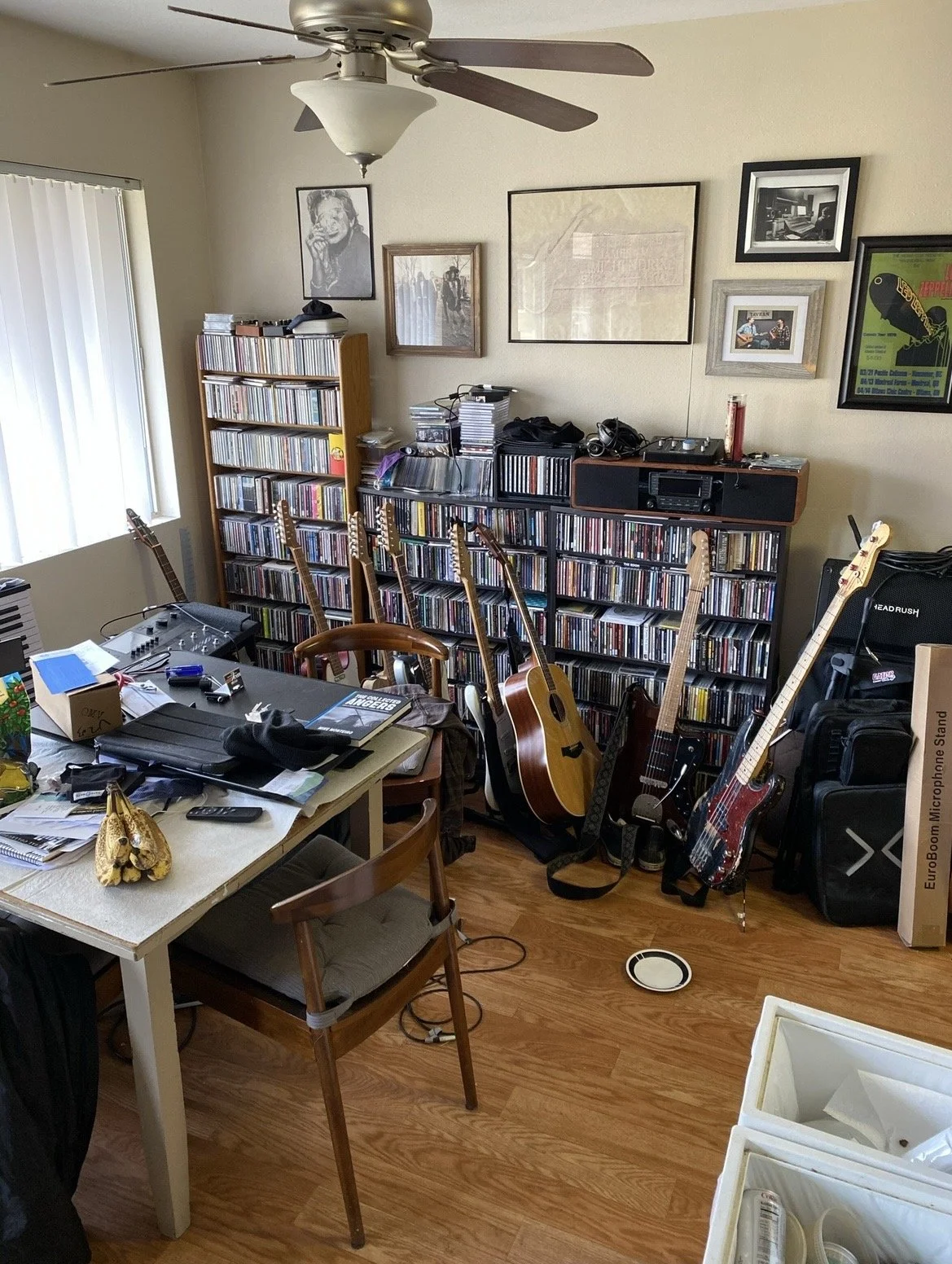
My “office”, Sunnyvale, CA, circa 2020. ‘Bout time to throw out those bananas…
It was, obviously, a horrifying period. I’m sure I don’t have to remind you. Dystopia. Uncertainty. A complete lack of unified leadership on the federal level. A friend of mine kept a computer monitor devoted to tracking the ever-increasing tally of Covid deaths. Patrice and I had the added stress of being 2500 isolated miles away from virtually everyone we knew and loved, watching helplessly as our our native Ohio seemed (from our hypervigilant vantage point, at least) to be treating common-sense health and public safety policies as half-joking suggestions.
Shit was dark.
And yet…
And yet…
If I’m really being honest, there’s a part of me that looks back on that period with…well, ”fondness” isn’t the right word; I know far too many folks who experienced devastating trauma and tragedy. But if I can separate my personal corner of it from the horrors of what the world as a whole was going through, there’s an almost nostalgic flavor to the way I think of those days. We were fortunate that Patrice still had her job. Money was still coming in (a lot of people weren’t so lucky). The notorious Bay Area traffic was down to a trickle (One could get from Sunnyvale to San Fransisco in well under an hour), and the air got quieter and clearer. And -crucially- the introvert in me really enjoyed the lack of social obligation. I’ve always gravitated to solitary pursuits and, when I wasn’t working on my radio show or watching Chernobyl on Netflix (GREAT choice of escapism there, Tod), I was finally getting time to learn my way around GarageBand, writing songs for my next chapter as a solo musician.
At the time, I had just moved west and left behind Shrug, my band of brothers with whom I’d had a 26-year run in Dayton, Ohio. I had also been playing with the Motel Beds, John Dubuc and the Guilty Pleasures, and literally dozens of other past projects, stretching back into the early 90s. And, while I had regularly sprinkled a lot of acoustic solo sets into my schedule, I had always been a band guy. I’ve heard many different musicians refer to bands, especially young bands, as gangs. I could relate. I was not an athlete, so I didn’t have the experience of a life of being on teams; I got my version of that in the scruffier, less organized, more dysfunctional rituals of a bunch of friends in smelly rooms and vans, pouring all of my confusion, anger, joy, and ambition into making a racket for a roomful of likeminded believers. It’s good work if you can get it.
And so it came to pass that, in those early uncertain days of Covid, I sat at my little kitchen table-turned-”studio”, pondering a course for my new solo career, remembering past glories and indignities, and wondering if I’d ever get to do any of that stuff again. Words started coming:
Busting out of the cornfields and factory towns
Twice as good as you’d think and just as bad as it sounds
May I present to you the four musketeers
A little bit too pie-eyed and wet behind the ears
A little older than their guitars
And quite a bit younger than their years
Nineteen forever
Nineteen forever
Place your bets and put your money down
Nineteen forever
Nineteen forever
These kids are always gonna be around
They pooled their pizza tips, a Prehistori-conoline Ford
Coughin’ down the highway and preachin’ on three truths and a chord
Three drink tickets and a percentage of the door
Opening for someone you never heard of before
Doesn’t matter if you’re out of gas
and crashing on some local kid’s floor
The boys are back in town
Spread the word around
They were hard as nails and sharp as a knife
Then the drummer found himself a job and a wife
The other three are hooked now, man
They’re in this for life- what a life
What a life
Nineteen forever
Nineteen forever
Place your bets and put your money down
Nineteen forever
Nineteen forever
These kids are always gonna be around
The music started as a kind of shuffle, not light years from the stuff we used to do in the Motel Beds but, as it went on, it began to take on more and more of a Thin Lizzy vibe. Normally when this situation presents itself I try to steer the song in another direction. But this one caught me in a nostalgic mood, and I decided to lean into the Lizziness, with guitar harmonies, my best approximation of Phil Lynott’s delivery, and a couple small cases of outright petty lyrical larceny.
It’s very crude (bear in mind, I was early in my Garageband journey), but a lot of fun.
You can hear it by clicking here, if you want. I’d like that.
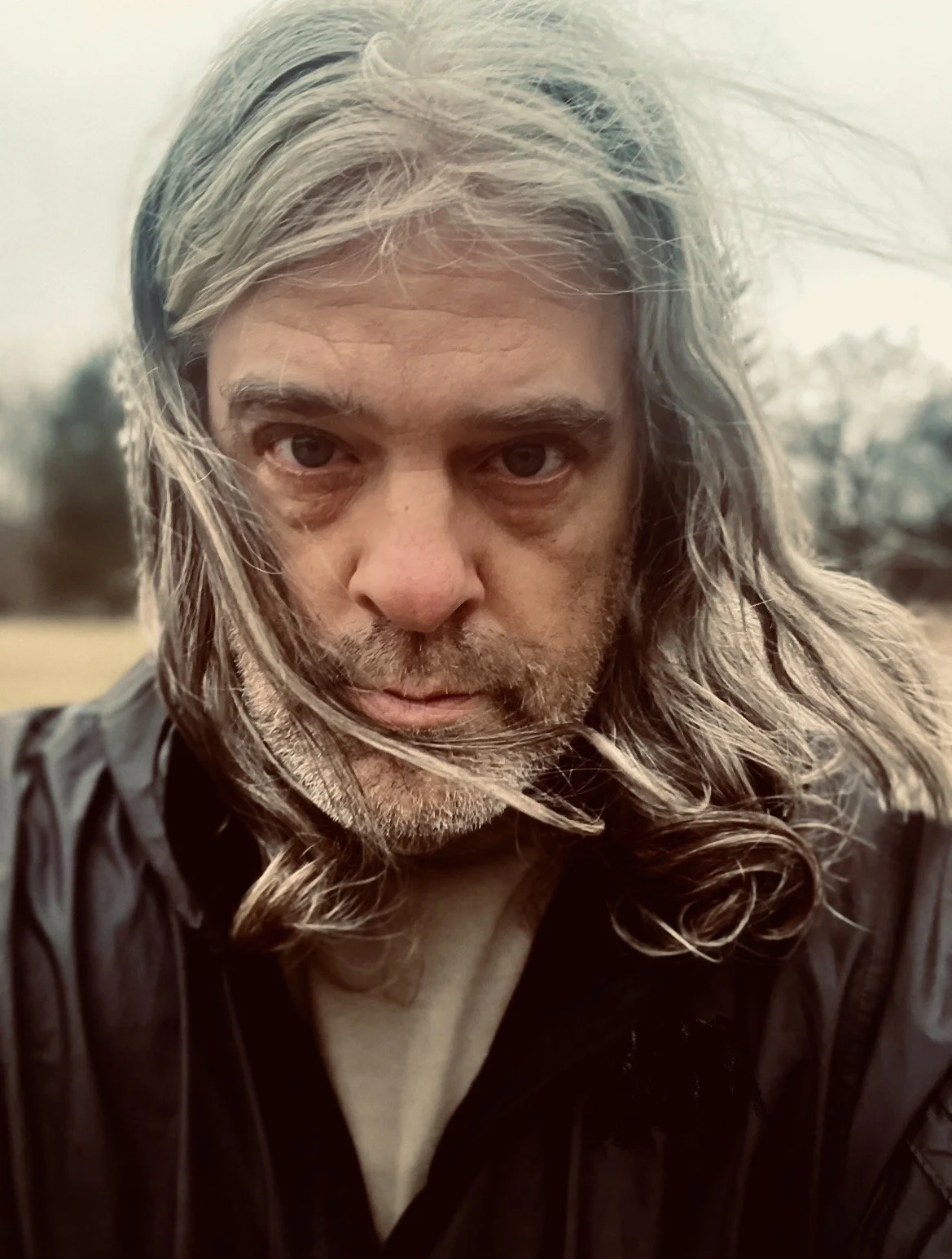
TOO MUCH MACHINE
So, I guess this is a blog. Welcome to my blog. Let’s get bloggin’.
I’m putting these posts under the same moniker as my mostly dormant Substack account. I had high hopes for that platform, but got kind of disenchanted with it as I watched it slowly, inevitably turn into yet another version of Facebook, with a bunch of reposted videos, echo chambers, and such. I don’t really have a plan here, beyond trying (trying, mind you) to make whatever this is a weekly thing, and to give you something to read on a regular basis- disjointed, garbled, and scattershot as it’s bound to be. I have a lot of noise in my head, but I can make an educated guess that these posts will be touching on a lot of music and art, songwriting, maybe some essays, scattered fiction, half-baked (but passionate) socio-political diatribes, more navel gazing than is probably necessary (or healthy), and general gobbledygook. It’s also entirely possible that the occasional balderdash, falderal, and poppycock will surface. No promises, falderal fans. Let’s just see what happens, shall we? Hell, I’m just glad you’re here.
Happy Year of the Horse, everyone. Here’s hoping that new, magnificent beast finds you with your saddle, ready for the ride ahead. I’m no expert on Chinese Lunar Years but, as I understand it, this new one is all about change; shuffling off that which doesn’t serve you, ditching baggage, and entering a new period of creativity and enlightenment.
That last part sounds pretty damn good to me, as it no doubt does to all folks who consider themselves “artistic types”. The middle part about shuffling and ditching does, too, because I’m tracking in a fair amount of mud on my boots from the Year of the Snake (more on that in a bit). It’s that first part, the “change” bit, that has me a little shook.
Call it my Midwestern Anglo-Saxon upbringing, blame it on my Zodiac sign or my generally undramatic middle class childhood, blame it on the bossa nova, but I’ve not, as a general rule, been a big fan of change. I like stability. I like dependability. I don’t care for chaos. And, seeing as how chaos is the coin of the goddamned realm these days, you can probably guess how my last year or so has been going.
And I’m betting that you’ve been feeling it, too- the vertigo that comes with non-stop outrage, existential dread, and the ever-expanding awareness that our entire reality has been built on radioactive sand with scotch tape and snake oil by a cabal of soulless, morally-bankrupt, power-hungry, pedophilic monsters with more money than they could ever possibly need and an apparent immunity to consequences. For over a year now, I’ve not really felt like myself. It’s as if I’ve been on crazy pills and, while a bit of Machine to rage against is useful to an empathetic, creative person, too much Machine can be exhausting and paralyzing. And that’s pretty much where you can usually find me lately: on the corner of Exhausted and Paralyzed. As a result, I feel like a traitor to my chosen vocation; at a time when I should be churning out art at a furious clip, I wrote exactly one (kind of shitty) song, in November, just squeaking in under the wire of a year that should have been a goldmine of righteous inspiration.
Then, in December, my father passed away at 96, after a long struggle with dementia. Watching the kind, brilliant man I knew and loved slowly disappear over a decade and grappling with the concept of grieving someone we essentially lost years ago dropped a final, rotten cherry on top of the already very Emo sundae that 2025 had become. As such, I’ve been vacillating between “too many feelings’ and “dead inside” with alarming and dismaying regularity.
Jesus. This post has taken a turn. Again.
Confession: this is actually my second attempt at writing this piece, and I keep ending up in this dark neighborhood. But you know what? I’m gonna lean into it. I’m not writing this to vent (OK, maybe a little, but not just to vent, anyway). I’m writing this for the same reason most of my songs skew a bit towards gloom. Once upon a time, when I was spinning out about the general lack of mirth in my music, my wife, who is smarter than I’ll ever be and an expert at talking me off the ledge, told me, “your music makes people feel less alone.” It was a good and overdue reframing of what I had, up until then, considered a weakness. Don’t be ashamed of or embarrassed about your dark side. We all have one, and it can be useful. Toxic positivity divorces us from reality. If you’re feeling bad, it means you still care; you still believe that things can be better than they are. We just have to find a way to keep what everyone from Horace to Winston Churchill to Nick Drake called “the Black Dog” on a leash.
Writing and playing music is my main way of controlling that dog, and by far the most dependable one. Traditional clinical therapy is problematic for me. I know it works for a lot of folks, and I’ve done it myself, and it felt..alright, I guess. But I can’t shake the feeling that I already know what I need to do going into it, that everything the therapist is going to tell me is basic common sense, and that I’m wasting both parties’ time. I know it’s a cyclical thing for me, and I just need to ride it out, while trying not to cause harm or stress to those around me. Overthinking? Underthinking? Cop out? I don’t know. Ugh. Brains, amirite?
Your world, your reality, is a suit. You put it on. It’s a baseline, generally comfortable enough to function in, a bit restrictive in its tailoring, but you make it work. Over time, it gets threadbare. It doesn’t fit right. It falls out of fashion. The powers that be tell you that a new suit is too expensive, your old suit is the one you have to wear, and that everything will fall apart if you change it. Fuck that. This suit sucks. It’s started to smell, and it doesn’t serve us anymore. It’s time to go shopping. I’m not really talking about suits.
As for me, I’ve got my eye on a new suit for 2026. It’s simple, timeless. Understated, but well-made. Sharp, but functional. It’s a little pricey, but everything worth the trouble is. And it’s a change, something I’m trying to get better about embracing.
Oh- and it’s a good suit for riding, I’m told.
Giddyup.